
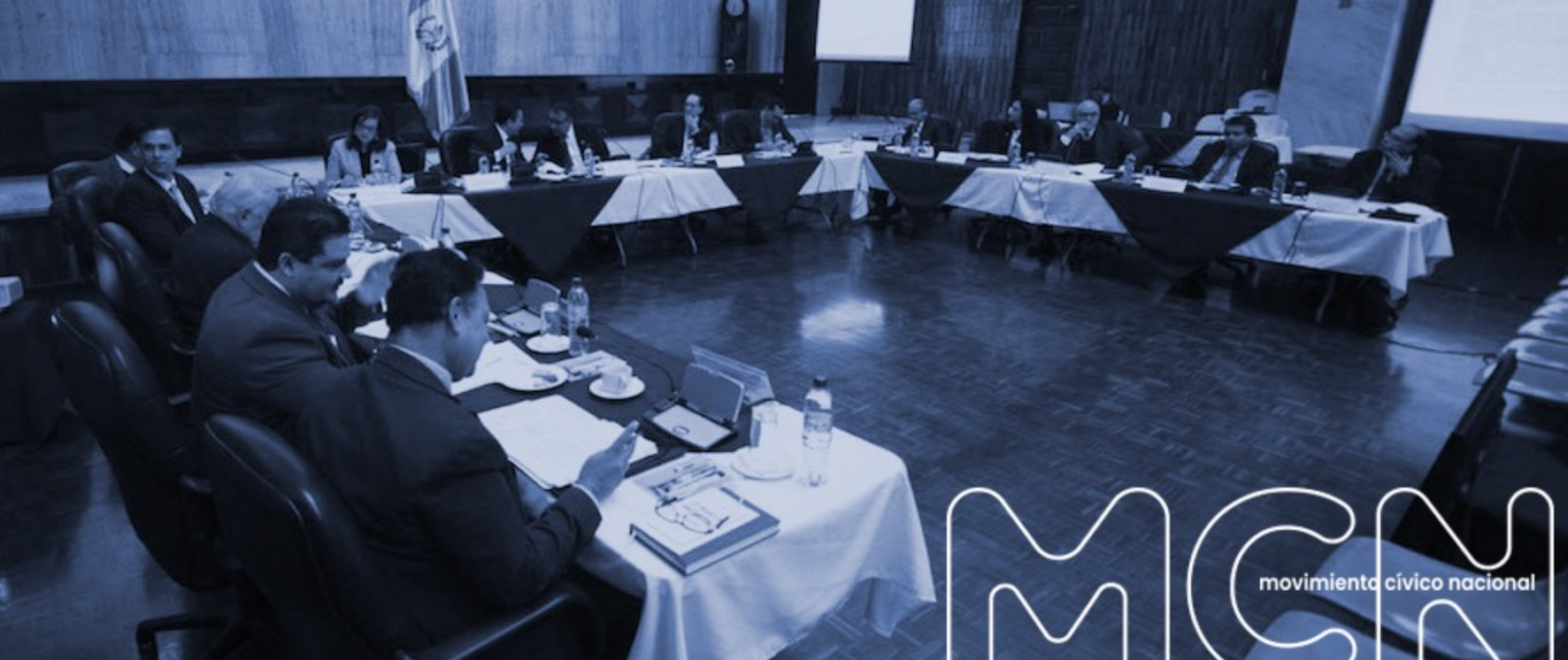
Last Wednesday, June 5, the Congress of the Republic once again called for the integration of the Postulation Commissions for the election of magistrates of the Supreme Court of Justice (CSJ) and the Court of Appeals. Each of these institutions plays an extremely important role as a guarantor of the country's democratic republican system.
Here you can find answers to some of the most frequently asked questions about postulation commissions and learn why they are relevant to all Guatemalans.
What are they?
Postulation commissions are a group of people designated by law who meet to qualify and select candidates for Magistrates of the Supreme Court of Justice and the Courts of Appeals according to the requirements specified by law (articles 1 and 12 Law of Postulation Commissions); subsequently, Congress elects the new Magistrates from that list.
Postulation commissions are temporary bodies established for the election of high-ranking officials of different legally established institutions (article 1 Law of Postulation Commissions).
What is their function?
Postulation commissions have several functions:
First, to establish the additional requirements for the election of candidates to be included in the list that is then submitted to Congress or the President of the Republic for the election of the leaders of the institutions prescribed by law.
Second, they must analyze, seek, select, and approve the best professional and academic profiles, considering ethical aspects, professional service, social projection, and academic background of the candidates.
Third, they must form the different lists based on the number designated by law, which is then submitted to the selecting body (Congress) to lead the institutions stipulated by law.
Who are they composed of?
The composition of the postulation commissions will depend on the officials to be elected:
- For the Supreme Court of Justice and the Courts of Appeals, these are composed of (Articles 215 and 217 Political Constitution of the Republic of Guatemala) :
- A representative of the Rectors of the Universities of the country
- The deans of the Faculties of Law or Legal and Social Sciences of each University in the Country (currently 12)
- An equivalent number of representatives elected by the General Assembly of the Bar Association and Notaries of Guatemala.
- An equal number of representatives elected by the titular magistrates of the Court of Appeals and the Supreme Court of Justice.
Let's ensure that prepared and honest officials committed to Guatemala are elected to guarantee democracy and the rule of law in the country. Learn more
How is the process carried out?
1: Congress calls for the respective commission to be established according to the officials to be elected. The commission is established, and its members are determined.
2: The Bar Association votes to elect its respective representatives to the commissions.
3: A formal analysis is carried out, including the reception of objections and evidence against the objections of potential candidates.
4: The substantive analysis begins, and candidates who could potentially be included in the list are interviewed.
5: This is the last step, where the commission selects candidates by vote. Once elected, the list is submitted to Congress.
What law regulates them?
The laws that regulate and develop the mechanisms, procedures, and specific objectives of the postulation commissions are the Law of Postulation Commissions, Decree 9-2009, and the Political Constitution of the Republic of Guatemala.
It is our responsibility and duty as Guatemalan citizens to inform ourselves and learn about these processes. In them, it is decided who will hold the highest positions in the administration of justice in the country. Understanding the nature of these processes makes us more attentive citizens and opens our eyes to the impact they have on our daily lives.
Let's use this knowledge to ensure that prepared and honest officials committed to Guatemala are elected to guarantee democracy and the rule of law in the country.