
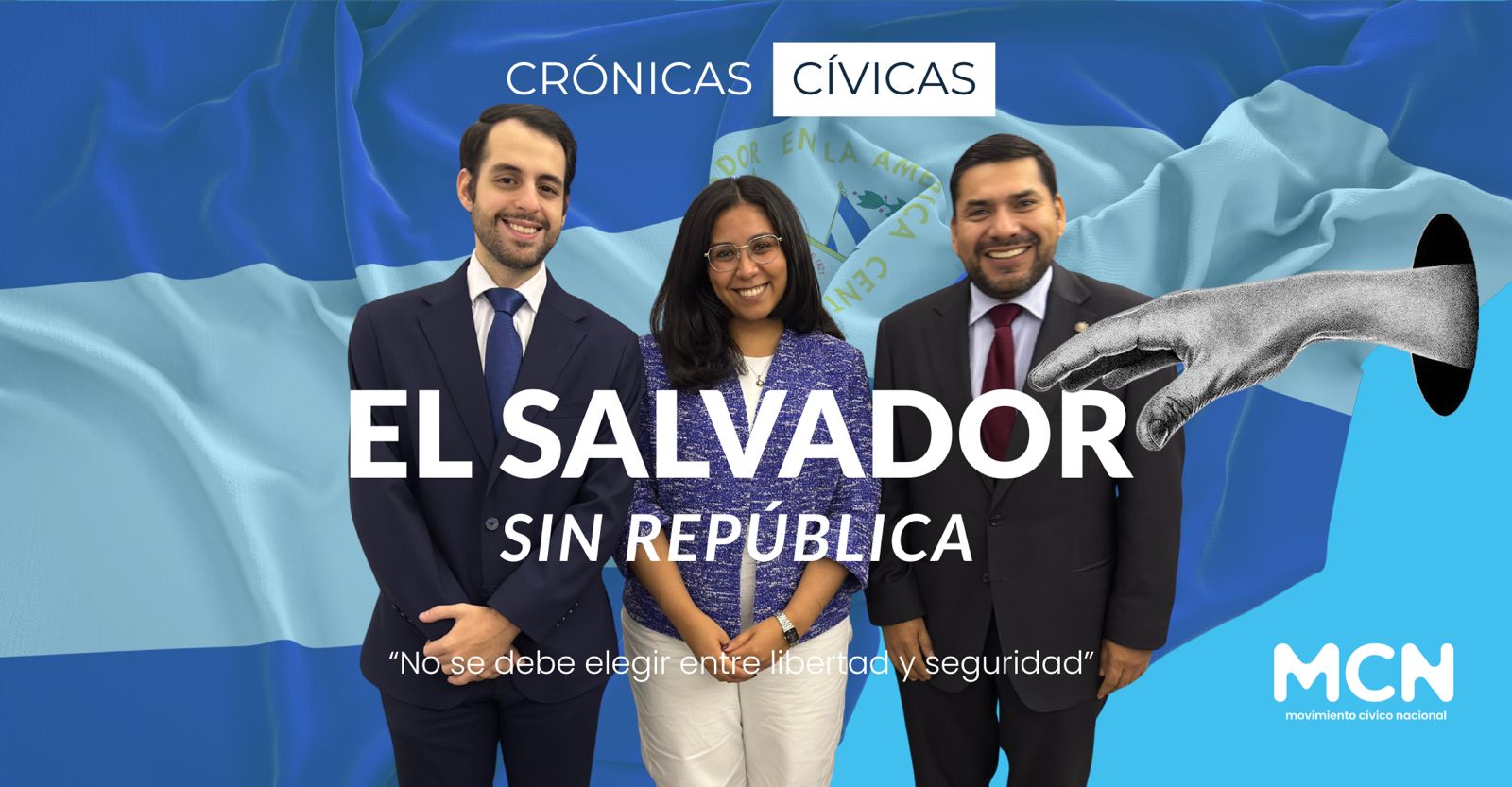

In this edition, titled "El Salvador Without a Republic," we welcomed two guests: Francisco Lira, a Salvadoran deputy from the ARENA party, and Rafael P. Palomo, a political analyst. Together with them, and moderated by our president, Christa Walters, we shared a deep analysis of what is currently happening in El Salvador and the risks its model poses for the region.
We talked about power and limits, about authoritarian temptation disguised as efficiency, about the paradox a nation faces when it must choose between applauding immediate results or defending eternal principles. Between firsthand accounts and in-depth analysis, we understood something that history insists on reminding us: when a society gives up the Republic in the name of security, it ends up losing both.
From the beginning, we remembered that our commitment is not to individuals or parties, but to principles. We believe that freedom, life, and justice are inalienable, and that we cannot fall into the trap of choosing between security and freedom as if they were opposing options. During the panel, this paradox was precisely discussed: Nayib Bukele's popularity versus the evident weakening of institutional checks and balances. We emphasized that the concentration of power is never compatible with a solid Republic.

Francisco Lira recounted how, from the opposition in the Legislative Assembly, the absence of checks and balances against the Executive is experienced. His words reminded us of the importance of the separation of powers, a principle we defend because it guarantees balance and protects citizens from abuses. Rafael P. Palomo, for his part, explained the paradox of a government with very high approval ratings that, at the same time, weakens fundamental freedoms and silences citizen voices.
Another central point of the conversation was the state of exception. We recalled how, although it has supposedly reduced violence rates in El Salvador, it has done so at the cost of restricting fundamental rights. In this contrast, the key question was raised: what is more dangerous for a republic, citizen insecurity or the concentration of power?

The dialogue also addressed the situation of the independent press and freedom of expression in El Salvador, issues that deeply concern us. It is extremely worrying that when a country has no press freedom, there is no informed citizenry, and without informed citizens, no democracy is possible. Hearing how journalists and opponents face consequences for scrutinizing the government was a wake-up call we cannot ignore.
In the final exchange, both panelists agreed that Guatemala must be alert. It was emphasized that Guatemala is not immune to repeating similar experiences if we do not firmly defend republican values: accountability, transparency, and citizen participation. We believe the lesson is clear: we must not fall into the temptation of applauding quick solutions that rely on the concentration of power.

We closed the day convinced that spaces like these are more necessary than ever. We made this edition of Civic Chronicles at the MCN a reminder that the defense of the Republic is not the task of a few, but the responsibility of all citizens committed to freedom. We remembered that true security can only be built on the basis of respect for the law and republican principles.