
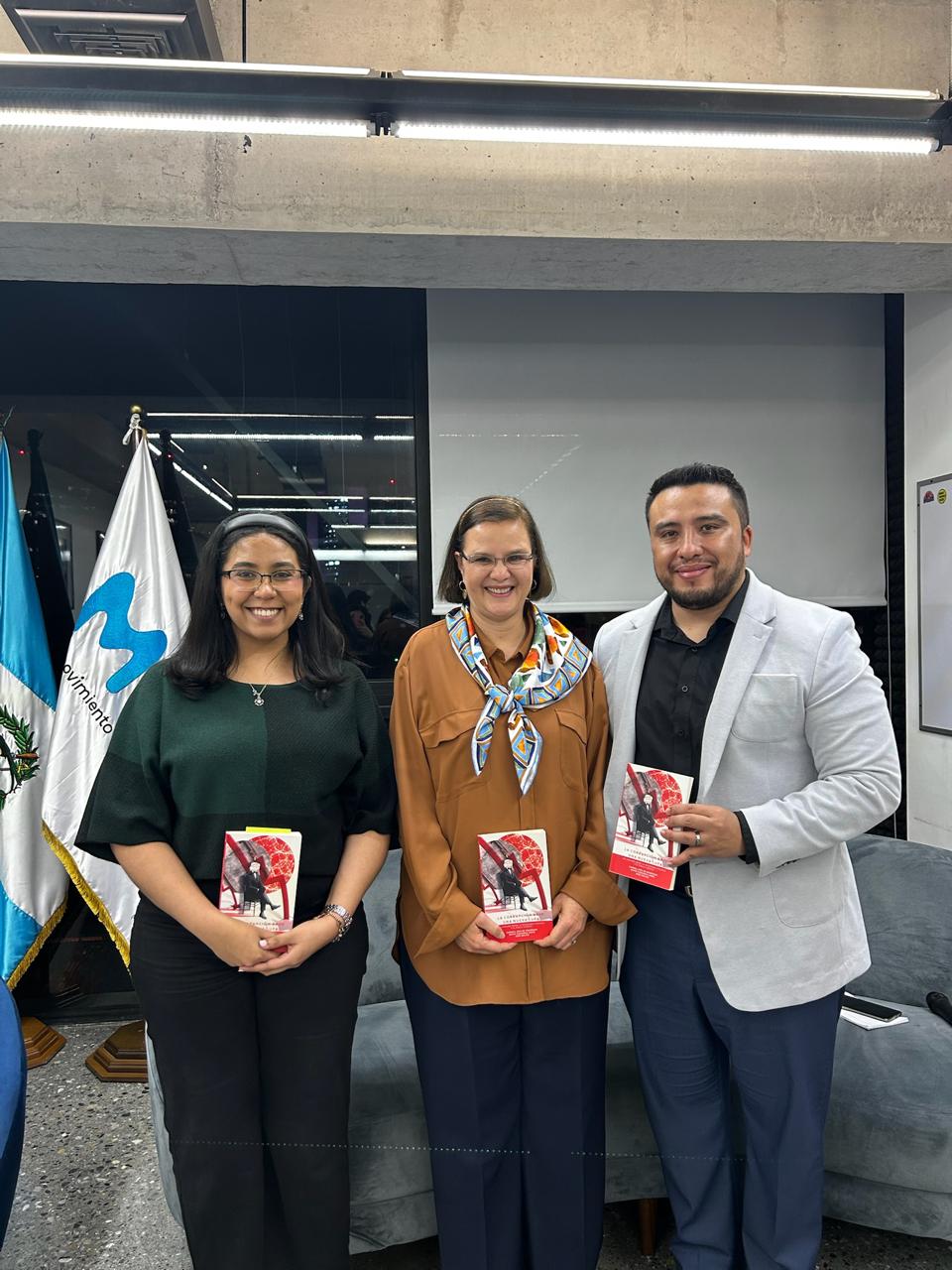
During the Civic Chronicles, the book "Corruption under a New Lens," authored by Carroll Ríos, David Casasola, and José Gálvez, was presented. This publication evaluates corruption within a 20-year framework in Guatemala, from a new point of view, using models from two schools that contribute to the analysis of corruption: economic analysis of public decisions and econometrics. With the help of the Atlantic Council's new index of governance indicators (and perception of corruption), an evaluation of variables is proposed that allows for identifying the correlation between corruption control and freedom in Guatemala. That is, the loss of economic freedom leads to an increase in the perception of corruption, imposing new challenges for governmental corruption oversight procedures.
Corruption perception and transparency indices have multiple limitations due to stereotypes about the phenomenon and the role of government, as well as businesspeople. For this reason, the authors believe that there is a close relationship between economics and politics to understand the variables that feed each other to comprehend trends in the observed phenomenon in Guatemala and Latin America. In this way, the economic analysis of public decisions allows for a microeconomic approach to why people act as they do in the political arena, where incentives rule.

This microeconomic contribution is complemented by the macroeconomic part addressed in the text to tackle corruption. That is, to understand how and why decision-makers act as they do, it is important to consider the context in which they do so. Guatemala, being a lower-income country, suffers from low institutional maturity that prevents higher quality corruption control. Although the text does not propose a solution recipe for corruption, it seeks to emphasize the patterns that have occurred in the country (and its neighbors) to recognize and prevent present and future scenarios.
During the activity, one of the panelists states that in studies of this type, one should not talk about correlations or biased conclusions, but rather objectively, in order to understand the influencing variables in countries like ours. Although the economic analysis of public decisions has not yet been developed in detail on corruption, its tools can so far be used for observation and research. For example, as the authors do in the book, it is possible to identify a new course of action that frames a conversation about the variables that interrelate corruption and economic freedom. Even using new measurement formulas, the results obtained are similar to those of large institutions such as the World Bank. Additionally, the value of civil liberties, institutional maturity, democratic strengthening, and accountability have been considered for better corruption control.
During the Civic Chronicles, the authors affirm the value of institutional strengthening as a determining factor for achieving better governance conditions that can control and reduce corruption, achieve economic liberalization, guarantee the strengthening of civic and individual liberties, and ensure the consolidation of the Republic of Guatemala.
If you want to know more about the National Civic Movement and participate in its activities, don't forget to join the Membership Program here.