

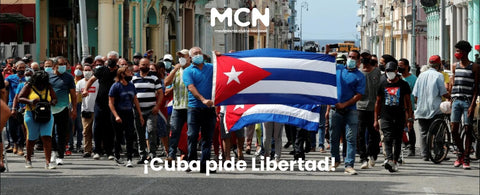
“Cuba is ours! Cuba is not yours! Freedom!” were some of the most forceful messages heard in Cuba when citizens protested last Sunday to reclaim the most important thing: their freedom.
Cuba has experienced its largest demonstrations in the last 3 decades. After 62 years of communist dictatorship, Cubans have come out to protest against the lack of food and the health crisis they are experiencing due to the lack of vaccines in the country. However, this economic crisis is something Cuba has been experiencing for many years and it has worsened even more with the pandemic.
As the National Civic Movement, we support the Cuban people's plea for the swift recovery of their rights and freedoms. Currently, Cuba is still under a military dictatorship, a relic of a Cold War communist revolution. The international community has the duty and the opportunity to call for a free and democratic future in the country.
The situation in Cuba for over 60 years
Cuba has been a communist country since 1959. Communism in the country has weakened the economy and affected the population, who have suffered the most from the repression of their freedom for over 6 decades.
As is common in these communist regimes, there is control over the economy and food prices. The economic crisis that has been ongoing for years due to communism in Cuba has been hit even harder by the pandemic.
A protest that began over power outages and demanding COVID-19 vaccination transformed into calls to reclaim freedom and demand political changes in the country.
A country that failed to achieve freedom after its revolution
Those who protest are very clear about what they demand: their exhaustion with the economic crisis, deprivations, and the state of their freedoms.
After the revolution in Cuba, many thought the country was destined to be more just and egalitarian. However, time has passed and has shown the opposite. Communism led them to live in misery.
Now, 62 years later, the world is witnessing the resurgence of a feeling of freedom among the Cuban people.
The last time a large number of people strongly opposed the regime was during the Maleconazo in 1994.
The protests seen in recent days are the largest the regime has faced since taking power.
As is characteristic of authoritarianism, thousands of people who oppose the regime have been beaten, imprisoned, and killed for demanding freedom.
As it is not a democratic country, Cuba lacks judicial independence, freedom of the press and expression, or free and fair elections.
Arbitrary arrests, as seen in that country, are part of a tool to achieve political objectives in dictatorships and continue to promote communism.
The repression continues
Cuban President Miguel Díaz-Canel has delivered a clear message: "we will be in the streets fighting." The regime caused internet outages, which made it difficult to transmit news of the protests. Furthermore, it prohibited journalists and activists from leaving their homes to document what was happening.
It is too early to say what the outcome of what is happening in Cuba will be. The most positive scenario would be one in which the dictatorship ends. An end where the rule of law is restored and limits are placed on the tyranny of Díaz-Canel, who wishes to end freedom and individual rights for the sake of his dictatorship and political aims.
Hopefully, the outcome will be one where Cubans can recover what is most precious: their freedom.
What is important are the lessons a country like Cuba leaves for the rest of the world.
Why pay attention to what is happening in Cuba?
Cuba is a dictatorship; President Díaz-Canel's political power in the country is absolute over its citizens. Living in a democratic regime means that citizens can limit that power to live their own lives without the interference of those who hold power, which is not the case in Cuba.
Practically, Díaz-Canel, in his statements regarding the demonstrations in the country, is emphatic in saying that he will not allow anyone to advocate for him not continuing to hold absolute power within Cuba, that he will not allow ideals different from those of the Revolution or alternative political proposals to those of the communist party. This use of violence to remain in power and the censorship of Cubans' freedoms are a reflection that the country lives under an authoritarian regime.
Throughout Latin America, it is increasingly common to see citizen protests calling for political changes. The important thing is not to neglect our democracies, as they are not infallible systems. Citizen participation will always be key to counterbalance the State and the governments in power so that they do not turn their public power into an arbitrary and limitless one.
Protecting our democracy requires effort, and it is vital to exercise active citizenship that counterbalances and limits arbitrary and discretionary power that can threaten our fundamental freedoms and rights.
That is why it is important to learn from the lessons of Cuba and understand that the strengthening of institutions and citizen participation are vital to stop those who wish to destroy the rights and freedoms of citizens.