
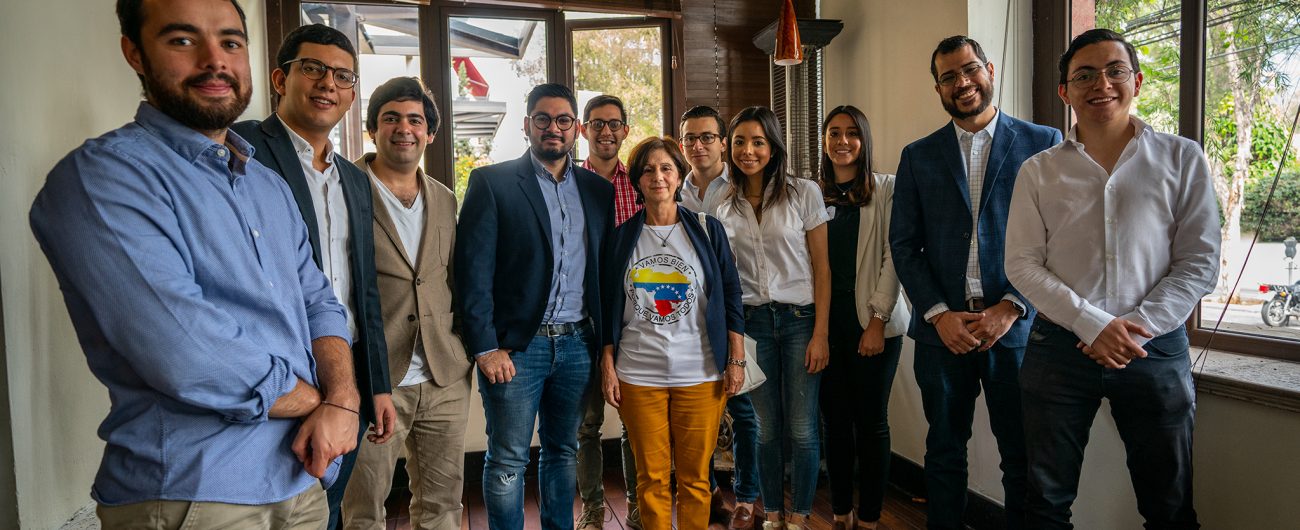
Last Saturday, March 9th, together with Dr. Maria Teresa Romero, the new Venezuelan ambassador to Guatemala, we discussed the causes of Venezuela's fall into populism and the current events that offer hope for the country's future. In a tense national context where appointments to state representation positions are made according to quotas, she is currently the only ambassador appointed by consensus. She is a professional in opinion and investigative journalism, with extensive experience communicating in radio and print media.
It is thanks to this experience that she was able to share with us some of the causes that led her country to its current complicated situation. She explained how certain circumstances make societies more susceptible to populist government strategies. In the Venezuelan case, we find a particular juncture in which, after an era marked by social mobility and economic development driven by oil, the population deeply resented the fall in oil prices and the publication of several government corruption scandals.
The fall in oil prices revealed how precarious the country's economic situation was, despite having seen an improvement in the quality of life for a large number of its inhabitants. The profitability of oil had quickly made it the engine of local development, displacing other activities such as agriculture, which had historically played an important role.
As stagnant conditions set in, the conditions for a populist regime began to consolidate.
Social and opportunity differences became increasingly pronounced as possibilities for social advancement dwindled, the middle class remained inert, and no actions were taken by the upper classes to set a clear direction. Therefore, individual liberties began to take a back seat to the clamor for change and the arrival of a savior.
All of this was strategically exploited by Chavez who, identifying the opportune moment, began to attempt actions to seize power, which first materialized in an attempted coup. He maintained his determination even after being released from prison, running for and winning the presidential elections. The rest is the well-known history of disguised authoritarianism and institutional destruction called Chavismo. A history that, even today with the new interim president Juan Guaidó, seems to be approaching its end.