
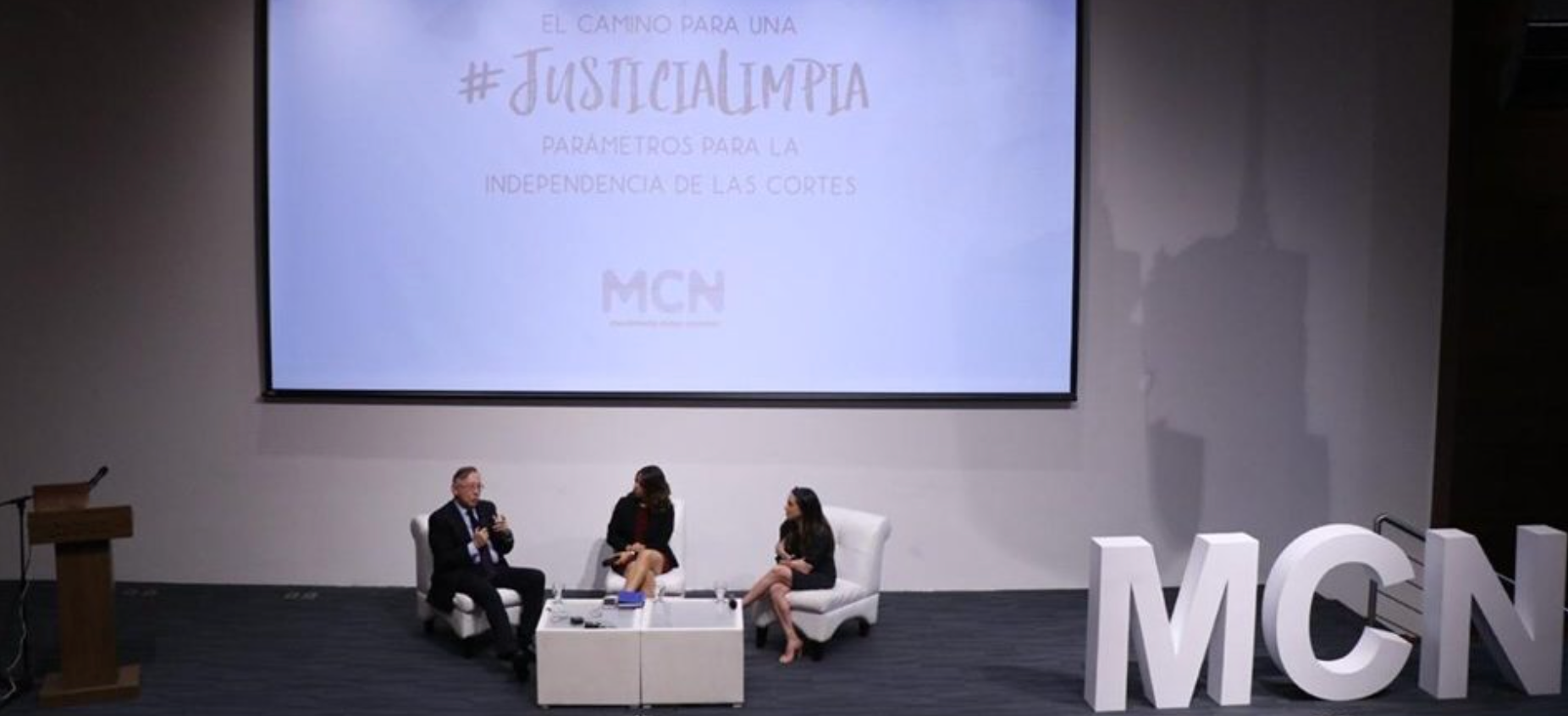


On August 6, we held the event The Path to Clean Justice: Parameters for the Independence of the Courts with the aim of reflecting on the postulancy commissions for electing magistrates of the Supreme Court of Justice and Court of Appeals, which are soon to be sworn in and begin their work. Due to the institutional change that will take place this year in the three branches of the State, it is necessary to highlight the relevance of justice in Guatemala, as it is the only branch of the State that is not renewed through popular vote. Therefore, the process of the postulancy commissions presents a new opportunity to achieve clean justice and strengthen the administration of justice.

During the first half of the event, we had a panel that included the participation of María Isabel Carrascosa from the law firm Sigüenza y Carrascosa and Hernán Pérez Loose from the Vance Center. Here is a summary of the topics:
- There are different mechanisms for electing judges. It can be through popular elections, as in the United States, they can be appointed by another branch of the State, or they can be elected through postulancy commissions, as in Guatemala.
- Postulancy commissions have a European tradition and were implemented throughout Latin America to include different sectors of society (academia, lawyers, and judges) in the process of electing judges to curb the hyper-presidentialism of making all decisions. However, it has not been a perfect model. One of the major problems is that postulancy commissions are easily politicized.
- The reflection on the issue of independence leads to separating different types of independence. There can be the ideological independence that judges must have, the institutional independence of the judiciary with respect to the other branches of the State, or the independence of one judge over another judge.
- The most important is institutional independence. This refers to the absence of external pressures on the judicial body, which is reflected in transparent election processes, accountability, and long terms for magistrates.
- Regarding the postulancy commissions in Guatemala, the challenges that the commissioners will face were pointed out. Due to delays in the process timeline, there is much pressure for the commissions to complete their work before the legally established deadline. Furthermore, the issue of conflicts of interest among the commissioners is concerning because they must act with objectivity and transparency. Ultimately, the elected magistrates do not owe their positions to anyone in particular, or to the commissioners; they owe it to their preparation, their curriculum, and their honesty. Finally, scoring certain categories in the profile and grading scale is complex and requires serious and honest discussion by the commissioners who will apply it.
In the second half of the event, we presented the parameters that should be followed for the work of the postulancy commissions to align with the principles stipulated in the Law of Postulancy Commissions.

The overall process must be clearly defined, as well as the role of the commissioners and their responsibilities. The commission members must be independent and impartial to lend legitimacy to the process. The profile of magistrates to be elected must be established beforehand and include all expected professional, ethical, and personal characteristics. The profile must be consistent with the grading scale that will be used to evaluate candidates. Once in the phase of receiving challenges, the commission must provide mechanisms for citizens to submit them. The rigor of candidate interviews must include their stance on jurisprudential criteria, their professional trajectory, and merits.
The Movement recommends that the candidate profile reflect independence and impartiality. Candidates should have a history of irreproachable conduct and honorability. Furthermore, their legal knowledge should be appropriate for the position they are applying for, which means evaluating their academic background, analytical skills, and oral and written expression abilities. Equally important, they should also demonstrate a commitment to the protection of human rights, transparency, and republican values.
The renewal of the courts represents a significant change to which civil society's contribution is crucial. Generating discussion and ensuring that the principles of publicity, transparency, objectivity, and professionalism are met is the duty of citizens who will be monitoring the work of the postulancy commissions.