
Training on existing ideologies is vital. Any citizen who wishes to actively participate in what is happening in their country must be trained in this regard.
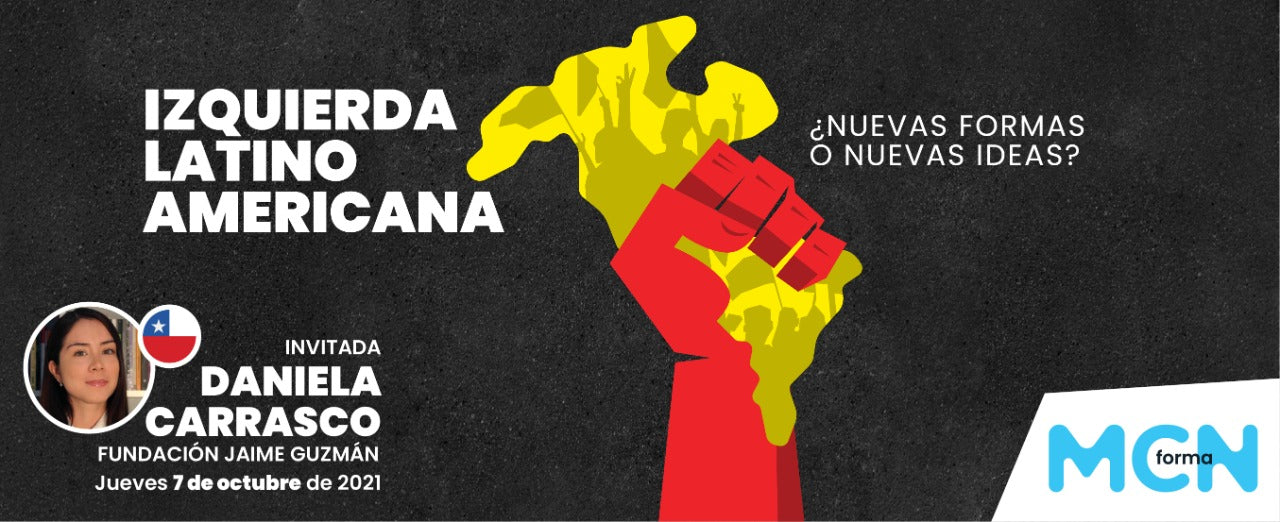
This time the National Civic Movement decided to hold a training event on the Latin American left. Daniela Carrasco, training manager of the Jaime Guzmán Foundation was in charge of leading this MCN Training.
What is the situation of governments across the region?
Carrasco began by explaining that the Latin American region currently has 9 right-wing governments, 7 left-wing, and 3 center-leaning. However, the expert explained that this situation can change.

In Carrasco's opinion, the electorate tends to punish governments in crisis scenarios, which has been seen throughout the region. This happens in economic and health crises as has occurred in recent years.
Left-wing social movements and outbursts in the region
First, there is the case of Bolivia in 2019 with Evo Morales and the electoral fraud. Another example is Chile, with the social unrest caused by a 10-cent dollar increase. In the expert's opinion, the concept of social unrest is not appropriate because it indicates that it is spontaneous. The increase in the fare generated frustration, and these emotions were exploited by some left-wing groups.
On the other hand, there is also the case of Colombia with the protests over the tax increase in 2019. Another outburst occurred in Cuba with its "Patria y vida" protests. Finally, there is the case of Nicaragua with the protests against Ortega.
How has the class struggle evolved into social outburst demonstrations and marches?
Carrasco explained that to understand this, one must review Marxism. The expert explained that the part to pay attention to is post-Marxism, as it deepens the revolution in culture.
Therefore, the revolution must now be carried out in culture with ideas such as deconstruction.
Carrasco explained that classical Marxism referred to capitalist ideas such as the dictatorship of the bourgeoisie and that the State validated this dictatorship. Therefore, the proletariat had to carry out a revolution of rupture, founding a new state with the dictatorship of the proletariat. This would lead to socialism, which is a preliminary stage to communism.
Gramsci reintroduces the concept of cultural hegemony. He understood that in the 1920s, it was a hegemony that corresponded to the values and institutions of capitalism. Therefore, Gramsci's proposal is to direct or guide culture. The expert explained that this can also be understood as "manipulating" culture for political purposes.
“The conquest of cultural power precedes that of political power, and this is achieved through the concerted action of "organic" intellectuals infiltrated in all media, expression, and university environments.”
Antonio Gramsci
Deconstruction
Carrasco illustrated that deconstruction is one of the tools of the left. It seeks to reconceptualize, empty, or modify concepts and imaginaries. For example, they seek to deconstruct Western metaphysics. To break, shatter, displace binaries due to supposed hierarchies:
- Good – bad
- Man – woman
- Adulthood – childhood
- Human – machine
Therefore, by inverting hierarchies, everything can be something and at the same time nothing. It is a new political practice.
The Latin American Left Today
Carrasco concluded by explaining that the Latin American left today operates between horizontality and molecularity. Moreover, in these movements, there are usually no hierarchies; they are models of assemblies and councils.
Multiple movements with a multiplicity of desires are observed. It does not dialogue with the institutional language of formal politics; quite the opposite. The new left attacks at a horizontal, molecular level, intervenes in subjectivities, and uses deconstruction mechanisms such as transgression and mockery.