

The legitimacy of our institutions lies not only in the law but also in the trust citizens place in their electoral processes.
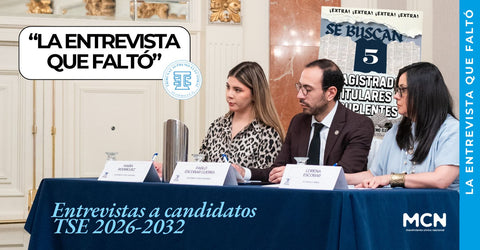
The current path to integrate the Supreme Electoral Tribunal for the 2026-2032 period reached a decisive stage with an unexpected void: the Nominating Commission finished its work without conducting public interviews with the candidates on the final list. Given this lack of a direct forum for scrutiny, the National Civic Movement and Guatemala Visible decided to provide a space for Guatemalans not only to see names on a list but also to understand the visions and capabilities of those who aspire to be the arbiters of our Republic.
A Risk for the Republic
The citizen initiative "The Missing Interview" was created with the aim of conducting public interviews, getting to know future officials and their capabilities before the final decision goes to Congress. What happens when we elect "blindly"? The lack of public scrutiny opens the door to discretion and under-the-table negotiations that have caused so much damage to the country. Without a space where candidates can answer difficult and standardized questions, Congress is left without technical input, and civil society without arguments for oversight.

We cannot allow the Supreme Electoral Tribunal to be composed of figures whose stance on law and ethics is a mystery. The uncertainty about the independence of the TSE is, ultimately, a threat to the stability of the Republic and the purity of the vote.
During the event, we established a rigorous methodology: each candidate had 20 minutes to answer 5 standardized questions. These questions were designed by civil society to address the most relevant and urgent issues of electoral management.
The invitation was extended to the 20 finalists, and the session concluded with the participation of five of them:
Mario Velásquez

Lesther Castellanos

Wilber Castellanos

Alfredo Skinner-Klée

Sergio Pineda

The candidates not only answered the questions proposed by citizens but also expressed their technical and legal positions, which were documented for public consultation.
This effort will culminate in the formal submission of a document of technical recommendations to the Congress of the Republic. The primary objective is to provide deputies with tools and evaluation criteria generated by civil society, allowing them to assess the suitability of the candidates with input that is not currently included in the official record.
By delivering the final product, the interviews, we seek to give Congress the opportunity to base its vote on robust profiles, strengthening political accountability in the integration of a professional and independent Supreme Electoral Tribunal for Guatemala. This initiative is directed at Congress and the citizenry; it seeks to fill a void, without representing or expressing support or endorsement for any of the candidates.

Through this, from the MCN, we demonstrate that transparency is the guarantee of the Republic; the republican eye ensures that magistrates are chosen based on technical criteria, backed by suitability.