

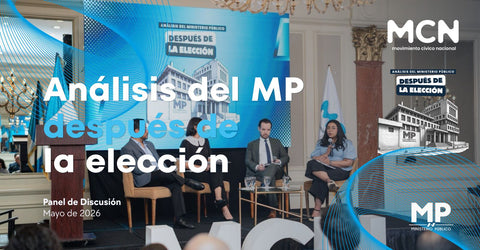
From the National Civic Movement, we opened a space to discuss one of the issues that has the most impact on the country's institutional future: the Public Prosecutor's Office. This time, the focus was on discussing what happened in the process of electing a new Attorney General, which led to the appointment of Gabriel García by President Arévalo. As well as the opportunities and challenges this institution will face to be more technical, independent, and sustainable over time. Through a presentation by attorney César Sigüenza, we reflected on the structural challenges of the election process. Subsequently, in a panel with diverse approaches, the need to strengthen institutions and the challenges facing the Public Prosecutor's Office in a context marked by new technological and citizen demands were addressed.

The panel included the participation of Mario Rosales, Francisco Quezada, Cynthia Ocampo and Christa Walters, who addressed various challenges related to institutional independence and the need to build stronger institutions. One of the central themes of the conversation was the urgency of having a clear, explicit, and measurable criminal policy, which defines priorities for criminal prosecution and reduces the margins of discretion. The panelists agreed that the Public Prosecutor's Office cannot continue to operate with implicit criteria, where priorities are inferred from cases, but rather must establish transparent guidelines that allow for the evaluation of its performance.
Another point discussed regarding the election process, through the model of nominating committees, was to question: "how is it verified that what is evaluated is rigorously verifiable?", especially because the selection processes seem to restart from scratch every time a new authority is elected and there are no standards for truly demanding evaluations. During the discussion, it was pointed out that the nominating committees law dates back to 2009 and, to date, has not been comprehensively evaluated or updated. Although there are currently higher transparency standards, problems such as the excessive breadth of evaluations and the lack of clear mechanisms to objectively verify the criteria used still persist. The need to establish more defined stages within the processes and to promote general reforms that prevent processes from being influenced by external interests of any kind was also discussed.
« The question is not who won, but what we can demand from officials, regardless of who is in charge: beyond complaining, we must demand with justification» (Walters 2026).
Another central theme was the importance of strengthening the independence of the Public Prosecutor's Office and preventing justice from functioning selectively. Christa Walters emphasized that the debate should not focus solely on "who won" the election of the Attorney General, but on what citizens can demand from authorities, regardless of the person who holds the position. In this regard, it was stressed that institutions cannot depend solely on those who lead them, but on clear rules, solid processes, and permanent accountability mechanisms.

Likewise, the panel addressed the new technological challenges facing the justice system. It was pointed out that "we are facing a technological monster" and that Guatemala needs to modernize to make strides in technology and artificial intelligence. Participants agreed that the Attorney General's relationship with technology will be increasingly important to confront new forms of criminality, strengthen investigative capabilities, and modernize institutional operations.

Finally, Pablo Escobar Guerra offered a message of reflection on the need to move beyond constant polarization between institutions and build mechanisms that generate greater stability and trust. Therefore, beyond the political situation, from the MCN we seek to promote a citizenry capable of demanding reforms with technical foundations and a commitment to strengthening Guatemala's institutions.