
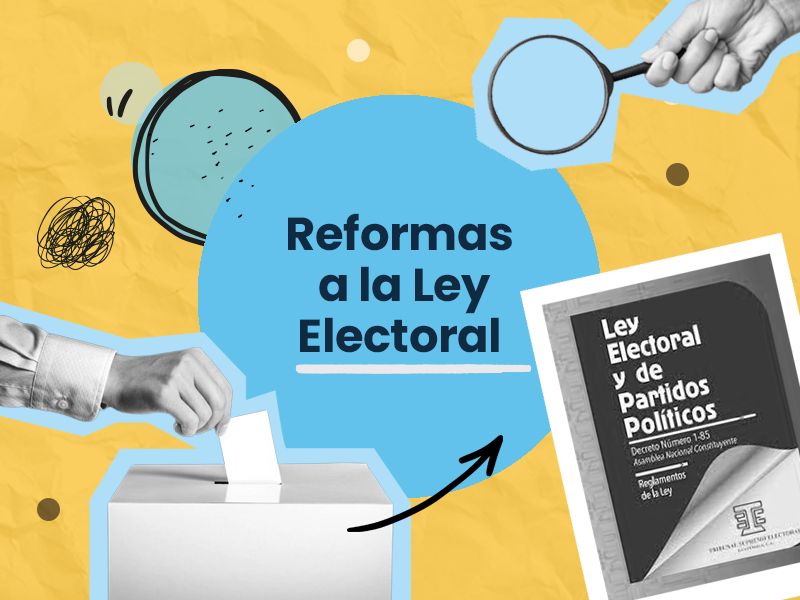

The results of the recent elections show several problems with the Guatemalan electoral system regarding representativeness and citizen participation. In the first round of 2023, citizens' discontent was reflected in the fact that 24.31%, almost one in four citizens who voted, did not feel represented or rejected the electoral options available. This citizen discontent is also evident in the high distrust towards the institution that should represent us, the Congress of the Republic. We need electoral reform now!
CAME: An opportunity to improve the Electoral System
The Electoral and Political Parties Law (LEPP) regarding CAME establishes that:
"At the conclusion of the electoral process, the Commission for Electoral Modernization and Updating (CAME) will be established, whose objective is to evaluate the completed electoral process and, if necessary, present proposals for appropriate reforms to the present Law.
Social, academic, and political organizations may submit their proposals to the Commission.
The Supreme Electoral Tribunal, if appropriate, will submit the corresponding bill to the Congress of the Republic, which must consider it before the end of the first ordinary period of the new legislature."
As Guatemalans committed to the Republic and participation, we present a citizen proposal to CAME. This is the second time we participate (2020 and 2024). We emphasize that any electoral reform must be aimed at improving representativeness and citizen participation. Therefore, our proposal is aimed at:
- Increasing representativeness: opening electoral lists and circuits.
- Facilitating citizen participation: electoral financing.
- Strengthening electoral authority.
🚨Hace unos días inició la CAME.
— Movimiento Cívico Nacional (@MCNGuatemala) March 15, 2024
🗳️En la primera sesión se habló sobre el sistema electoral.
📖Como movimiento presentamos una propuesta ciudadana para abrir los listados y que así podamos votar directamente por los candidatos a diputados . #reformaslepp #mcn #diputados… pic.twitter.com/YYEAImK4na
Let's open the lists!
Representativeness has to do with "the inclusion and representation of the preferences and identities of the electorate in Congress," as mentioned by Javier Fortín in the report Armando el rompecabezas. This is intimately linked to citizens' identification with their representatives. There can be no feeling of representation if we do not know who represents us. This is evidenced by the fact that, according to the Barometer of the Americas, 76% of the population distrusts Congress.
Currently, candidacies are through closed lists, which favors political parties and not citizens. This type of list makes it impossible for voters to show their preferences for candidates. They must vote for a package and the order established by the parties. We end up voting for logos, not faces. Eventually, these elected deputies do not account to those who voted for them.
Our proposal is to open the lists. What does this mean? That voters can choose any deputy from any party, voting directly for the candidate of their preference. For the assignment of seats, it is recommended to maintain the use of the current proportional formula, that is, the proportional formula distributes the seats in the order of the candidates with the most votes, not in the order of the blocked list currently provided by the parties. This way, representative proportionality is maintained and the direct relationship between the voter and their representative is encouraged, for example, to oversee their work.

Electoral circuits
The study "Humanizing Politics," which we conducted in 2021, reveals the perceptions and interests of the young population regarding the political and electoral systems. It highlights the low trust and low feeling of representativeness of the young population towards their representatives. Therefore, one of the recommendations of the young participants in the study was that the size of electoral districts should be changed "as they are currently too large."
Electoral districts are the constituencies under which deputies are assigned. In Guatemala, each department is an electoral district, with the exception of the department of Guatemala, which is divided into two, as there is the central district. There is evidence that in small districts, voters know the names and characteristics of their representatives better. Therefore, our proposal is to divide those departments that have more than 5 deputies into smaller electoral circuits. The debate about the constitutionality of this modification is extensive, so it must be taken into account that it should not violate the constitutional mandate that departments are electoral districts and the population criterion for their size.
Electoral financing
Participation is the "incorporation of political subjects," which are all individuals who consider themselves citizens; therefore, electoral participation goes beyond voting or being a candidate. The issue of political financing is relevant since citizens can participate by financially supporting one political party or another.
The resources received by political organizations must always be publicly known, and there must be transparency to access the list of financiers, amounts, and the destination of the resources.
Currently, the regulations related to financing are rigid and involve cumbersome processes for citizens who wish to contribute lawful resources to campaigns. We consider it necessary to eliminate the requirement of accounting books for individuals, but not for political organizations. An accounting receipt should be sufficient to verify a contribution. This facilitates citizens making contributions and, at the same time, balances their transparency. It is important to generate trust without undermining the citizen participation of those who wish to legitimately contribute to a political party.

A strong electoral authority
Everything related to changes to improve representativeness and citizen participation goes through the Supreme Electoral Tribunal (TSE) since it is the highest authority in electoral matters. The TSE's capacity for action and response must be strengthened. We consider it necessary to strengthen the internal functions of the TSE through administrative reorganization to separate jurisdictional functions from those of electoral organization and the oversight of political organizations. On the one hand, the Plenary of Magistrates should dedicate itself to jurisdictional functions of verifying that the internal directorates function properly. On the other hand, these internal instances or dependencies should be in charge of managing and overseeing by specialized professionals.

Clarify concepts
The disparate or discretionary application of norms has increased the judicialization and uncertainty of what the Electoral Law says. It is necessary to correct a series of norms modified in the last electoral reform in 2016 with the aim of guaranteeing clarity and certainty to citizens and political parties.
Among them is what is regulated with respect to early campaigning. The LEPP establishes that early campaigning is sanctioned; however, it does not specify what early campaigning is before the call for the electoral process. Therefore, ambiguity is generated, which results in great uncertainty about whether political leaders can or cannot express themselves on matters of national interest, as there is the possibility or fear that they may be sanctioned or even not registered. This ultimately contributes to citizen distrust towards political organizations or politicians. We need to know what politicians think to know which candidates best represent us.
Furthermore, this uncertainty harms the political party system, where these political organizations are expected to have a social function and weight in national events. We recommend clearly defining what early campaigning is and the sanctioning procedure to have certainty about the norm.
🏈Amidst so many Super Bowl announcements and news…
— Movimiento Cívico Nacional (@MCNGuatemala) February 12, 2024
👀Did you see the electoral law reform? pic.twitter.com/vPWeT455iQ
Let's go for reform!
The Republic requires committed and active citizens who exercise their civic duty. Electoral reforms are essential and must be for the benefit of the citizenry and the maintenance of a democratic, representative, participatory, and privilege-free Republic.
Join MCN and be part of those who change history!