
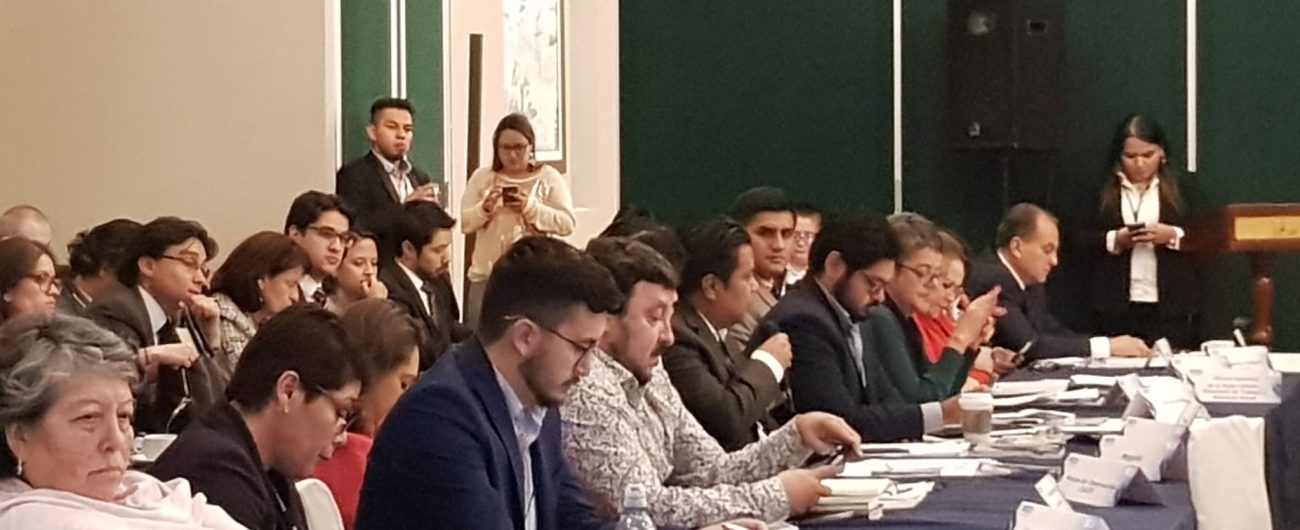
The Electoral and Political Parties Law regarding CAME states that:
“At the conclusion of the electoral process, the Commission for Electoral Updating and Modernization (CAME) will be established, whose objective is to evaluate the completed electoral process and, if necessary, present proposals for reforms that are appropriate to this Law.
Social, academic, and political organizations may submit their proposals to the Commission.
The Supreme Electoral Tribunal, if appropriate, will present the corresponding bill to the Congress of the Republic, which must consider them before the end of the first ordinary period of the new legislature.“
On this occasion, we participated in the Commission for Electoral Updating and Modernization (CAME) to present our proposals for improving citizen participation and representation. We not only presented proposals but also a petition for a critical and in-depth evaluation of the errors and problems that occurred in the last electoral process.
The Path to Electoral Reform that Fosters Citizen Participation
We view with concern the growing disillusionment of people with democracy in Latin America and Guatemala. Support for and satisfaction with democracy have stagnated; at the same time, trust in democratic institutions (national congress, political parties, supreme electoral tribunal, and local governments) has decreased in recent years according to LAPOP reports. In addition, Latinobarometro data indicates that three-quarters of the electorate believe that the legislature does not represent them.
The problems in Guatemalan democracy are related to representation and trust in institutions. Therefore, electoral reform must be aimed at boosting citizens' sense of representation and increasing their participation. This can only be possible under clear rules that are complied with and guaranteed by a competent electoral authority.
Our Participation in CAME
First Session
On January 17, CAME kicked off with a presentation evaluating the 2019 general elections by the Supreme Electoral Tribunal (TSE). However, this evaluation was not sufficiently critical and in-depth. For this reason, we emphasized the need to properly analyze and evaluate what happened in the 2019 electoral process before proceeding with any reform. This is to understand which electoral legislation is not adapted to the Guatemalan reality and to the citizens' expectation of a republican democratic model as set forth in the Constitution of the Republic.
Second Session
This discussion focused on the importance of representation. The main proposal from MCN and other organizations was to modify the way deputies to the Republic are elected. Currently, citizens do not trust the Congress of the Republic and do not feel represented because there is a separation between the candidate and the population; therefore, the proposal is to eliminate candidate lists by political parties and elect deputies directly to improve citizen representation.
Third Session
Topics on how to improve citizen participation in politics were discussed. One of the mechanisms that was discussed again was the impact of direct voting and internal competition within political parties to transfer candidate decisions to citizens. If we want a democratic republic with participation and empowered citizens, barriers to entry for parties must also be reduced. This is so that they are built from the bottom up, not from the top down, contributing to participation and their institutionalization.
Fourth Session
The conversation revolved around the electoral process. We highlighted some of the errors and deficiencies that occurred on election day and in the current regulation. For this reason, we proposed that a complete assessment and audit of the data transmission system is necessary, for example. Regarding the electoral call and calendar, we believe that time should be included to carry out system tests so as not to have to improvise on the fly.
Fifth Session
The topics of political organization financing and the media regime were addressed. We emphasized that the performance of the Special Unit for Control and Fiscalization of Finance should be evaluated to determine in which aspects it can be strengthened. Also, transparency indicators should be created to have greater certainty of the unit's functioning and of what political parties financially report. Regarding the media regime, we pointed out that by trying to equalize the conditions of political parties in terms of advertising, the real result was to disadvantage voters. Consequently, there was a lack of citizen awareness of the electoral offer.
Sixth Session
This session discussed electoral justice. We consider it necessary to have greater clarity regarding the sanctions regime before the electoral process. Sanctions should have a deterrent effect and their firmness should be known. Criteria for including or excluding candidates were also addressed within the subtopics. Our position is that there must be a uniform and coherent criterion on this. Also, the need to make public the reasoning behind the decisions made by the Magistrates. For example, the MCN requested to know the reasoning of the authorities who allowed the participation of transfuge candidates on two occasions; however, the TSE was unable to publicly provide information on the matter.
Seventh Session
Finally, the topic of strengthening the electoral body was addressed. This is only possible if it is accompanied by a separation of administrative and electoral justice functions within the TSE.
The Great Absentee from the CAME Sessions
As established by the Electoral Law, the objective of CAME was to conduct an evaluation of the recently concluded electoral process. Unfortunately, this critical and technical evaluation that we proposed and recalled CAME should undertake has not yet been carried out.
