
In the week of March 17-22, we screened the documentary "El Pueblo Soy Yo: Venezuela in Populism," directed by Carlos Oteyza and produced by Enrique Krauze, to four different audiences. The documentary features images and interviews that narrate the conditions in Venezuela that led to the Chavista regime. This regime will go down in history as a major case study on demagoguery in one of its most dramatic expressions: populism. This political phenomenon aims to connect an organization or individual with a "popular class" and then oppose an elite.
Why talk about populism?
The topic of populism was particularly relevant before the launch of political parties' electoral campaigns in the country. This was an effort to provide citizens with tools to identify openly deceptive and unnecessarily polarizing campaign strategies. These campaigns are also the first sign of populism as a system of government; developed by those who gain power with these strategies to undermine the institutions of countries and accumulate ever-larger shares of power.
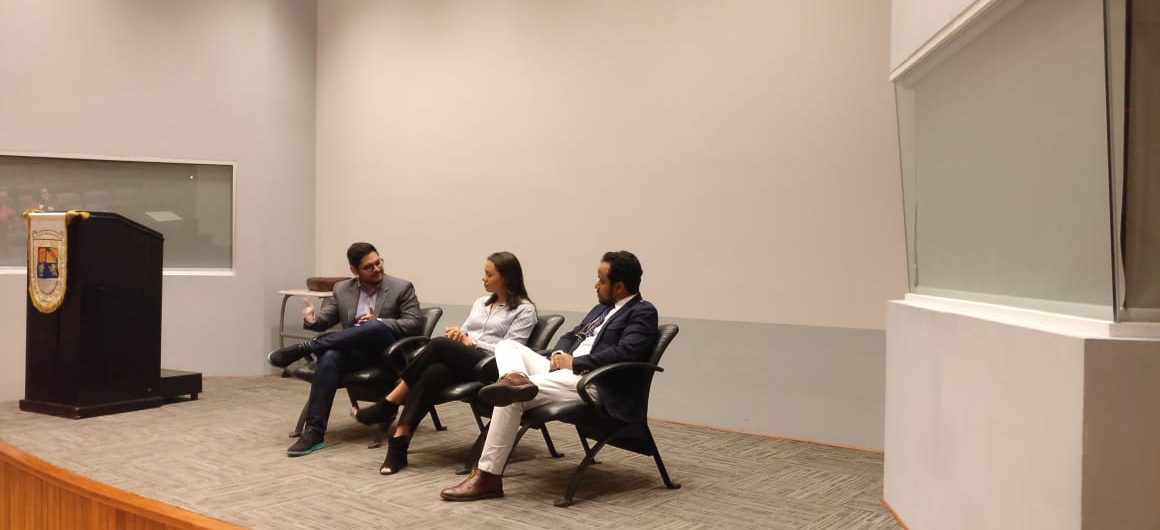
The first screening of the documentary was held with attendees from various areas of the community. The subsequent discussion panel took place between Roberto Ardón and Raquel Zelaya. They talked about how the images in the documentary should be a reminder of the importance of restoring value to politics and public service. About how democratic institutions should be protected despite the problems they might currently face.
Roberto Ardón emphasized the importance of preserving intermediate institutions such as churches and neighborhoods, as populism has the particularity of bleeding democracies, which are nourished and strengthened by a connected society. He also discussed how the constitution can be understood both as a political project to be developed and as a means of controlling Hobbesian power.
On the other hand, Raquel Zelaya pointed out some differences with the Venezuelan situation, such as the absence of figures analogous to Bolívar who could be exploited by power-seekers to legitimize actions of the type taken by Chavez. She also highlighted how the fact that we are a diverse population should put a stop to anyone trying to reduce us to a single "people." She also called for an end to silence and for young people not to be detached from politics, as when indispensable figures emerge, it creates an opening for populism to begin.
The second screening was held with film students who had an enriching discussion with the documentary's producer, Lorena Gonzalez. She explained how throughout the entire production, several elements were carefully considered, such as the tone and objectivity of the interviewees, so that the documentary would not lose its value as informative material. This was despite the fact that many of those involved are Venezuelans directly affected by the regime's measures, highlighted by the fact that the film has not been able to be openly and commercially exhibited in their country due to the context of repression. Despite these facts, she mentioned that it was of particular interest to them to study what happened through the prism of populism, since not all populisms manifest in the same way, and therefore this kind of material is needed to tell the story.
"Not all populisms are the same... Venezuelans already know this, but the film should be material to tell the story."
Lorena González
The third screening took place at UFM and included the participation of Adriana Thomas and Jesús María Alvarado as panelists. The subsequent discussion highlighted the social context that allowed Chávez's rise to power. An environment that was increasingly marked by inequality between social classes and where the population developed disillusionment with the elites of the time. The discussion delved into populism in the context of democracies, regarding how democracy, in purity, did not necessarily have an ideological burden requiring it to be more than a mechanism for political decision-making. However, when analyzing the success that democracies in Latin America have had in fulfilling their social program and promoting the well-being of their populations, there was agreement that in many cases, they have fallen short of the demands of their inhabitants. It was also commented how, in comparison with other regions such as Europe or North America, where populist campaign and government strategies have also emerged, in our sphere there is a real danger that populism could degenerate into authoritarianism.
The final screening took place in the Jorge Romero Imeri Auditorium of USAC, where we shared with political science students. The discussion in that forum focused on questioning some more specific details about populism. Especially regarding its comparison with other types of authoritarianism and totalitarianism. We discussed some possibilities, such as the separation between the discourse many politicians use in their campaigns and whether they can actually implement it in a populist form of government. And how this can largely depend on the strength of the countries' political institutions and the activity of a particular people in defending their best interests.