

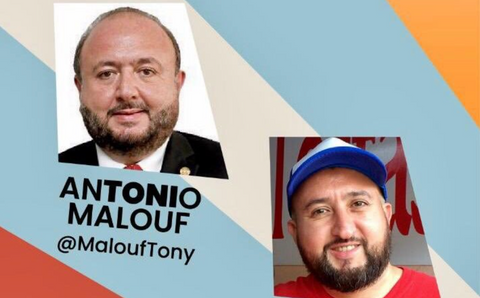
Why a dialogue with Mundo and Tony?
In this dialogue "What country do we want?", we had the opportunity to witness and converse with Antonio Malouf and Raymundo Ochoa in the first installment of the series: Dialogues "What country do we want?" This was a constructive discussion on political issues grounded in the daily reality of people who experience firsthand the effects of good or bad governance. The aim was to foster a better diagnosis of the main problems and concerns of the country and Guatemalans through different perspectives.
Tony and Mundo, as they amicably refer to each other, shared the story of how they met. A relationship that could easily have turned into bitter enmity ended up being quite the opposite. Due to their very similar appearances, upon seeing his image on someone else's profile, the then president of AGEXPORT and at the time of the Coordinating Committee of Agricultural, Commercial, Industrial, and Financial Associations (CACIF) thought it must be a bad joke and that the most appropriate way to react would be to report it to the authorities.
But unlike what one might expect from such a situation in the Guatemalan context, where people are traditionally portrayed as reactionary and distrustful, they decided to get to know and understand more about each other. So, they shared a "torta" (sandwich) in peace, prepared by Chef Mundo, and took the first step in a friendship that exemplifies something urgently needed in our country: the willingness to set aside differences and first impressions in favor of understanding and building common ground.
To our surprise, their concerns were very much aligned on important issues for the entire country. Each, from their own sphere, had fought against the effects of informality and institutional weakness in the country. Each had valuable testimony for the other and enriching insights for those who witnessed their interaction.
The story of how "munditortas" were born teaches us about the difficulties that even a well-prepared person with great enthusiasm to do things well can face in making an enterprise prosper in the country. In addition to the typical concerns that any entrepreneur might have, such as paying the payroll, staying a step ahead of the competition in price and service, and staying updated on the most popular trends in their respective industry... in our country, there are currently costs and pitfalls that are the result of a bureaucracy that does little to foster a good relationship between businesses and the State. And far from that, it sometimes seems to want to stifle and hinder the development of hardworking Guatemalans.
These unnecessary obstacles are the result of weak institutions where officials can abuse power arbitrarily, as well as a poor quality of public servants.
What was the dialogue about?
General challenges that affect all of us were discussed, such as the lack of legal certainty and insecurity. These issues have obvious and uncomfortable manifestations for every Guatemalan entrepreneur, who has sadly normalized living in anticipation of the next criminal who might try to appropriate others' work through violence turned into extortion or direct threats. But they also manifest in less apparent ways, such as the difficulty of accessing credit, which is the necessary impetus for businesses seeking to take the next step in developing their model or even to survive during a particular period of difficulty.
Both agreed on something that should be a distant concern for people whose main activity is not related to public life. And that is that political polarization ends up infiltrating spaces that should be neutral. However, due to the lack of seriousness of government bodies, other spaces, such as the social media of a restaurant chef and his relationship with a guild representative, can acquire more symbolic value for those who follow the development of public discourse than the pronouncements of an authority; as both have had to learn through their own experience.
Finally, some of the many specific issues regarding the regulation of small businesses were also addressed. These should be reviewed and improved so that others who perhaps do not have the tenacity, perseverance, and luck of the owner of "munditortas" do not have to see their dreams frustrated due to the state's failures in carrying out its responsibilities. The lack of adequate training for those seeking work in a kitchen might not be so outrageous if it weren't for the fact that the same entity that demands it, on the other hand, requires a series of rational permits and licenses to operate legally.
Conclusion
Thus, after our meeting with these two figures of Guatemalan society, we can conclude that we want a country where starting a business is easier. Where we don't have to fight against the state to develop a project, but rather where the state promotes it. And where dialogue, empathy, and honest conversation are the precursors of change for relationships between individuals.
Interested in participating in the next "What country do we want?" dialogue? click here