
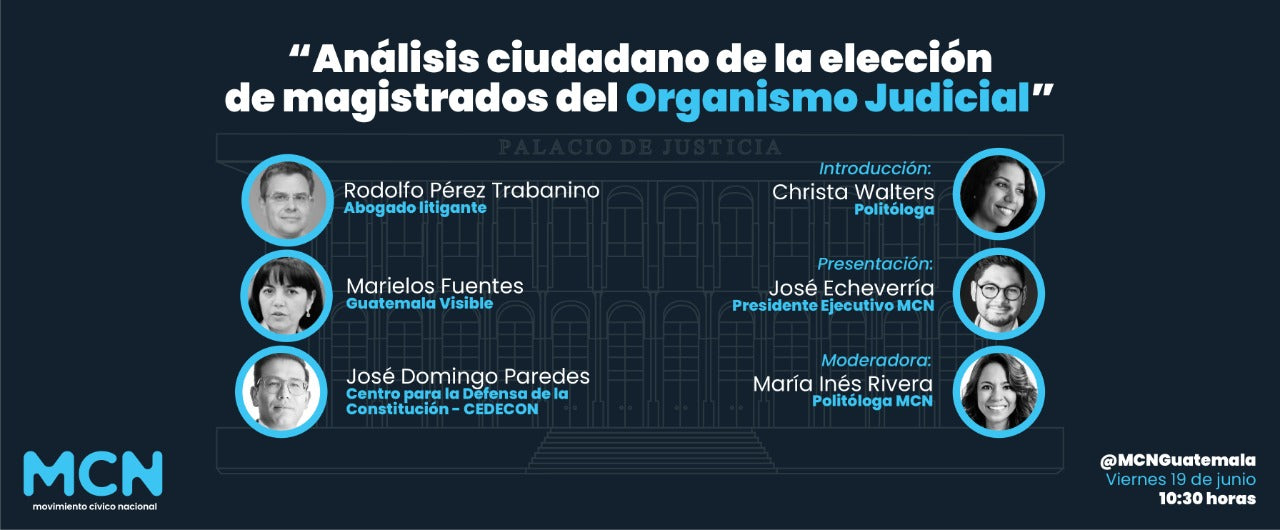

Analysis of the election of magistrates of the Judiciary. This election process has lasted more than a year and has been suspended and repeated on several occasions. Consequences and causes.
On June 19, the Webinar “Citizen analysis of the election of magistrates of the Judiciary” was held.
The Webinar addressed the main challenges of this election and the path that still remains to be taken for the election of the Judiciary, which is more than 8 months behind schedule.
October 13, 2019, was the date indicated by the Constitution for the renewal of the Judiciary. Eight months have passed and no new magistrates have yet been elected in the Judiciary.
Christa Walters, a political scientist, highlighted in the introduction of the event that the delay in the election of magistrates of the Judiciary has generated important reflections related to how the Constitutional election process has unfolded.
Christa Walters emphasized the importance of justice. In her opinion, the Judiciary holds the mechanisms for citizens to resolve their criminal, civil, labor, etc. problems. Therefore, it is the branch of government with which citizens will probably have the most interaction.
Ms. Walters highlighted that the election of magistrates was an opportunity to improve the Rule of Law in Guatemala.
The country ranks 101 out of 128 countries, showing a decline compared to last year in the Rule of Law Index, as a consequence of deficiencies in the administration of justice.
Data related to the election process of magistrates of the Judiciary
José Echeverría, executive president of the National Civic Movement, presented the main findings in the analysis of the election of magistrates of the Judiciary. This analysis compiles the monitoring that the MCN has given to this constitutional election process.
It was highlighted that there have been 4 legal actions that have prevented the constitutional election of the Supreme Court of Justice from being completed within the specified time.

In the opinion of the MCN, the Constitutional Court, in its various rulings derived from these 4 constitutional protection actions, has created a climate of uncertainty.
The uncertainty created by the various resolutions of the Constitutional Court that delayed the process is due to the elimination of certain pre-established mechanisms and norms in the Constitutional election process. This is especially true regarding when they should have been elected upon the expiration of the constitutional term.
The MCN's presentation concluded that the FECI report reflects a weak and inconclusive investigation, which does not provide sufficient evidence for a complete assessment that could be very useful to the citizenry.
The Public Ministry and the FECI did not present evidence to the citizens demonstrating clearly the flaws in the process, which is a pending task to be fulfilled, emphasized Mr. Echeverría.
He concluded by emphasizing that the Congress of the Republic must ensure a transparent election. The deputies have the task of defining the election method, taking into account the constitutional normative framework.
Citizen Reflections on the Election of Magistrates of the Judiciary
Marielos Fuentes, executive director of Guatemala Visible, referred to the constitutional appeals that prevented the election of magistrates. In Ms. Fuentes' opinion, the appeals did not resolve any of the problems that were raised.
The path to elect the magistrates of the Judiciary is established by the Constitutional Court's ruling and must be obeyed.
The path established by the Constitutional Court presents challenges as to how the deputies will comply with this resolution
Marielos Fuentes
Finally, she highlighted the importance of the Congress of the Republic receiving the proposed reform to the justice sector being presented by the Executive.
In her opinion, it is important that more Guatemalans get involved and contribute to these reforms forming a decent proposal that improves the election of our justice system.
The violation of the Constitutional deadline had serious consequences
Mr. José Domingo Paredes of the Center for the Defense of the Constitution highlighted that deadlines should have been respected as this strengthens the Rule of Law.
Mr. Paredes emphasized that CEDECON was one of the first voices to demand that the constitutional deadline be respected and constantly insisted that the Constitution was being violated. The Judiciary and its magistrates should have been elected in October 2019.
"As CEDECON, we insisted that the Constitutional deadline should be met. The deadline has now been relegated to a secondary level, having been violated by the Constitutional Court. Now, the ruling issued by the Constitutional Court must be complied with, an aberrant ruling that orders the election of magistrates despite what was indicated in the Public Ministry's report, as if nothing had happened and without taking into account that there are several lines of investigation into the entire process for possible corruption."
José Paredes
In Mr. Paredes' opinion, there is only one list submitted to the Congress of the Republic. The ruling issued by the Constitutional Court must be strictly adhered to regarding these lists.
Each deputy must orally justify their vote, in as many sessions as necessary, voting democratically, without any restriction or arbitrary pressure, candidate by candidate.
Mr. José Paredes emphasized that the extension of the Constitutional deadline had serious consequences. In his opinion, the Constitutional Court's ruling placed the magistrate election process in a scenario whose completion deadline is indefinite.
The Constitutional Court is the cause of the constitutional and institutional disorder we are experiencing, said Mr. Paredes.
Justice has not been a priority in Guatemala
In the opinion of Mr. Rodolfo Pérez Trabanino, the process of electing magistrates was flawed when the Council of the Judicial Career abstained from evaluating the magistrates.
Mr. Trabanino emphasized that the prosecutor's report does not contain accusations against the nominees for magistracies. In his opinion, the report merely describes a series of people who met with Gustavo Alejos.
The report makes clear a well-known fact: the candidates for the high courts who met with Gustavo Alejos have an ethical flaw in their honorability and orders Congress not to consider them, said Mr. Pérez Trabanino.
On the other hand, he highlighted that what we are experiencing is the product of an abandoned justice system
We are not capable of integrating a formally functional justice system. This has been the product of the abandonment of the justice system, a process of professional impoverishment that has been going on for a long time.
Juan Rodolfo Pérez Trabanino
In Mr. Pérez's opinion, we have had an abandoned justice system for many years. He emphasized that this must be the last time we elect high court magistrates under such complicated legal and political circumstances.