
What republican lessons can we learn from what happened in Bolivia?
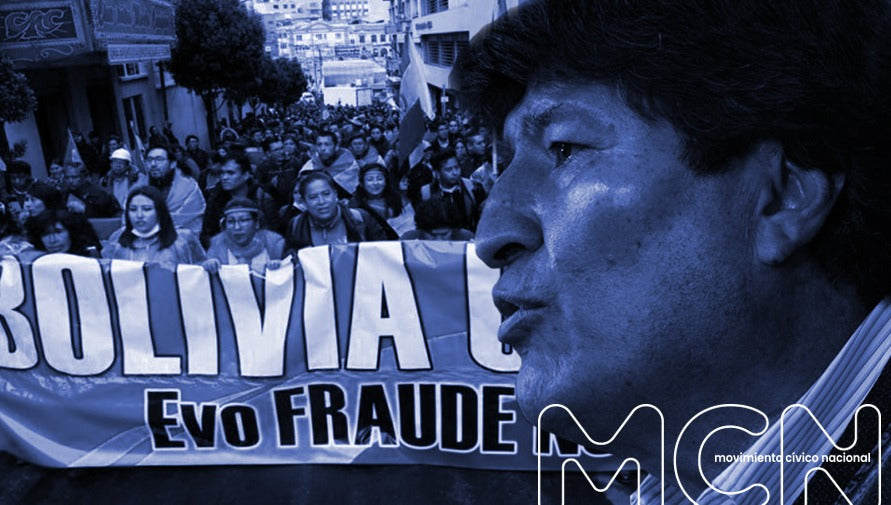
Dissatisfaction with Latin American democracy has increased in recent years. The issue has resonated more this 2019, with various citizen protests calling for social and political changes. However, last weekend's news focused on the resignation of Bolivia's president, Evo Morales. This followed three weeks of peaceful protests triggered by strong evidence of electoral fraud in the October 20 elections.
The unrest of the population in Bolivia has not only been due to the weakness of the Bolivian electoral court, the Plurinational Electoral Body, in issuing results transparently and continuously. Nor due to the other irregularities in the electoral process that the Organization of American States made visible in its post-election reports. The discomfort over the strengthening of anti-democratic institutions and the perpetuation in power of the Bolivian leader dates back to 2006. Since then, Evo Morales had been in power, systematically limiting essential rights and freedoms in true modern democracies.
As explained by the Human Rights Foundation's publication, Morales' government violated freedom of expression and association, filled the courts with his supporters, and kept the judiciary under his control to persecute political opponents and journalists, as well as perpetuate himself in power despite constitutional limits and the result of the 2016 referendum in which Bolivians voted to maintain existing limits on presidential term limits.
Can that be considered a democratic government?
Definitely not, much less a republican one.
Constitutions, in their classical and original form, must guarantee two things: the protection of individual rights and the limitation of power. Unfortunately, in Latin America, constitutions have been used for more than just these two principles. They have included endless articles with promises or mechanisms that allow them to be modified at the whim of whoever is in power. This is one of the reasons why populist leaders have been able to perpetuate themselves in power, taking advantage of the trust of their followers.
In Bolivia, Evo Morales was able to modify the constitution and interpret it in his own way to prolong his stay in power. This violated the republican principles of alternation in power, term limits, and the diffusion of power. These principles are important to prevent personalisms from coming to power and having the tools to arbitrarily interfere with the organization of the State or the private sphere of each citizen.
The protests
On the other hand, the protests in La Paz paint a scene often seen in similar situations. There are pro-democratic groups, others that incite violence to make the protests look bad, and a few who appropriate them to convey their message and not necessarily that of the majority. This results in problems associated with collective action. Nevertheless, violence promoted by paramilitary groups or civilian groups must be condemned. Order must be reestablished through the application of the law to guarantee peace and new, transparent elections.
The protests in Bolivia, as in other parts of Latin America, leave us with a great lesson. We must not neglect democracy because it is not an infallible system or one that can sustain itself. Nor should we neglect justice. This requires effort and citizen participation.
What the political situation in Bolivia shows us is that the separation of powers is essential to avoid the concentration of power. This is only possible under a rule of law that guarantees that no man is above the laws or can distort them at will. The decisions made by Evo Morales showed that, if the judiciary is in one's pocket and the Constitution is modified, despotic feats have no limit. That is why it is important to look at what has happened in Bolivia. To understand that the construction of republican, inclusive, and legitimate institutions is necessary to curb the impulses of those who want to destroy freedom and individual rights for their particular interests.