

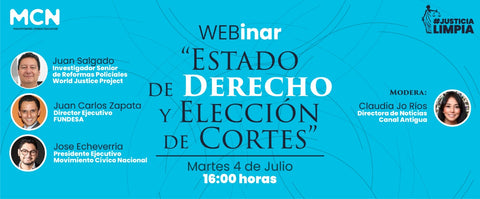
On Tuesday, August 4, the Webinar: Rule of Law and Election of Courts was held. Juan Salgado, senior police reform researcher at the World Justice Project; Juan Carlos Zapata, executive director of FUNDESA; Jose Echeverría, executive president of MCN and Claudia Jo Ríos, news director of Canal Antigua, participated in the conference.
Dr. Juan Salgado began the Webinar and referred to the composition of the Rule of Law, emphasizing that it is a broad term that encompasses different factors. It implies a relationship between legality and legitimacy for the functioning of a democratic country.
For the World Justice Project (WJP), the Rule of Law involves several factors:
- Limits to government power
- Absence of corruption
- Informal justice
- Open government
- Fundamental rights
- Order and security
- Regulatory compliance
- Civil justice
- Criminal justice
The Rule of Law Index developed by the WJP measures these factors in 128 countries. They do this through surveys of the general population and questionnaires to experts.
Dr. Salgado indicated that Guatemala worsened in the ranking. There were changes in the factor of limits to power and absence of corruption.
Currently, Guatemala ranks 101st out of 128 countries.
Juan Carlos Zapata added that a Rule of Law is a system of rules in which all persons, institutions, and entities are subject to the law and it is applied fairly and with respect for human rights.
On the other hand, he mentioned that access to justice is limited. As a result, efficiency is 30%; out of 100 cases, only 30 reach a sentence.
Finally, Zapata highlighted in his speech that the lack of clear rules inhibits investment in any country.
Discussion on the election of courts
Jose Echeverría mentioned that Guatemala has a low and worrying evaluation in the rule of law index. As a result, one of civil society's concerns is justice.
Although it might seem that the election of courts is far from the citizenry, it has effects on our daily lives.
In the 2019 process for electing magistrates, a constitutional deadline was not met and new magistrates have not been elected currently. He mentioned that the election process has been extremely tumultuous due to various actions that the current Constitutional Court has consented to; and that the evaluation of the results these constitutional actions have had does not seem to be positive.
Finally, Echeverría emphasized that the transition of power is fundamental. Checks and balances are an essential part of a Republic and that certainty is lost as power transitions are not carried out in a regulated and orderly manner.
On the other hand, for Dr. Juan Salgado, the delay in the election of courts had an impact on Guatemala's evaluation in the Rule of Law Index.
To clarify, Salgado stressed that the variables influencing the low priority given to the renewal of courts should be reviewed, as it was an irregular phenomenon.
Finally, on this issue, Juan Carlos Zapata added that the delay in the election of magistrates implies a lack of certainty.
Zapata emphasized that the voting procedure that Congress must follow, due to the Constitutional Court's resolution, prevents us from having new magistrates soon, this as a consequence of the country's weak institutional framework.
The impact of the Rule of Law on Guatemala's development
In Juan Carlos Zapata's opinion, the delay in the election of magistrates generates a lack of certainty in the resolutions of the Judicial Branch.
Zapata emphasized that there is a lack of legal culture in Guatemala and stressed that strengthening the Rule of Law is beneficial for generating investment.
On the other hand, José Echeverría highlighted the importance of having a government of laws and not people, a government that does not depend on who temporarily holds power.
Finally, Echeverría stressed that the uncertainty surrounding the election of magistrates results in a political crisis where resolutions lack confidence.
Above all, citizens do not trust that authorities are legitimate and to what extent the enforceability of resolutions goes, Echeverría highlighted.
How to achieve this strengthening of the Rule of Law?
Juan Salgado emphasized that this process must be evolutionary. Salgado stressed the importance of conducting a comparative study of how other Latin American countries manage to elect the judiciary within constitutional timeframes.
On the other hand, he emphasized the role of citizens and that they must be willing to comply with the rules; civil society must play an active role in generating data and presenting it to public authorities.
Changes in public management can be achieved from the information and data generated by civil society, Salgado emphasized.
Juan Carlos Zapata agreed with Dr. Salgado that strengthening the Rule of Law must be an evolutionary process for institutions. He noted that Guatemala has regressed in some aspects but improved in others.
Finally, José Echeverría said that it was not possible to talk about the Rule of Law without mentioning what happens in the courts.
It is important to guarantee checks and balances, to limit power in an orderly manner and by following established norms that provide certainty and legal security.
Echeverría and Zapata agreed that, as part of this change, there must be reforms to the election of magistrates. Both agreed that magistrates should remain in office longer to ensure transparency.
Additionally, José Echeverría said that the election should take place in stages, at different times and periods, the important thing is to promote the judicial independence that we so much desire, he highlighted.