
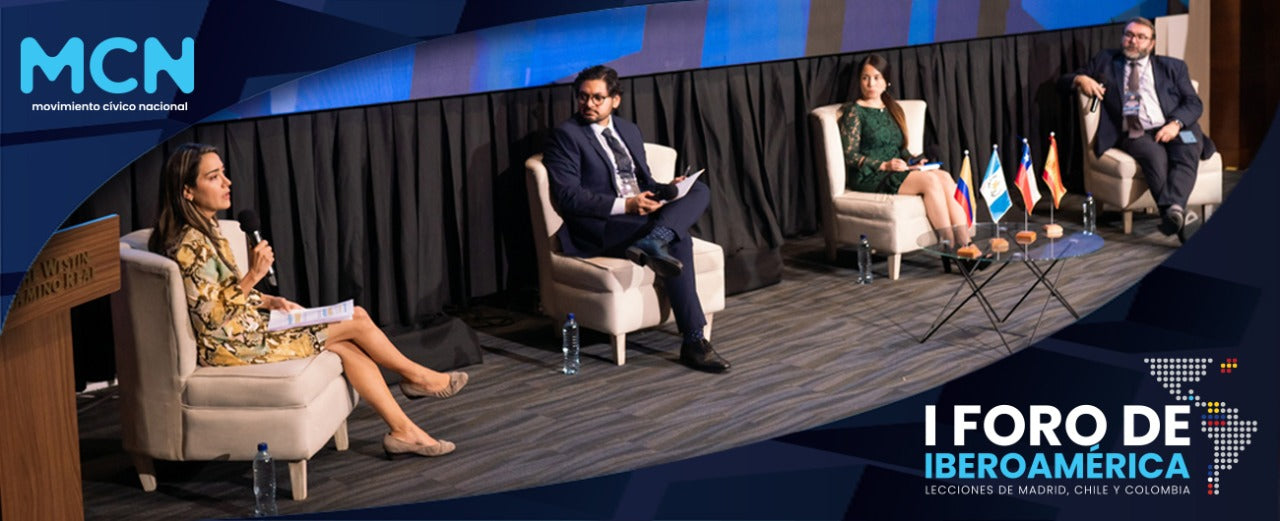
The first thing I want to highlight is the freedom we have to hold this forum in Guatemala and to reflect on it, emphasized the Executive President of the National Civic Movement at the beginning of the Ibero-America Forum.
Ibero-America Forum is a space for discussion and analysis of political processes and efforts that through populist and destabilizing mechanisms have sought to achieve public power in Ibero-America.
In this first version of the Forum, an analysis of the political processes in the cases of Spain, Chile, and Colombia was carried out.
Participants in the Ibero-America Forum
The event was attended by Juan Hurtado, the Ambassador of Colombia to Guatemala.
From Spain, we were joined by Eduardo Fernández, Doctor in Political Science and Director of Studies and International Area at Fundación Disenso.
Maria Clara Escobar, internationalist and Executive Director of the Hernán Echavarría Olózaga Institute of Political Science, was in charge of presenting the political situation in Colombia.
Finally, Daniela Carrasco, political scientist from Fundación Jaime Guzmán, addressed the political process in Chile.
The Executive President of the MCN opened the event by expressing his admiration for the citizens who are fighting today to defend and recover their freedoms. He also emphasized that there are issues in Ibero-American countries that need attention:
- Lack of strong institutions
- Corruption in the use of public power
- Lack of opportunities
- A justice system with little or no credibility
- Accepting violations of the law depending on who commits them
We must pay attention to these alarms to ensure we protect and improve the institutions of our democratic Republic throughout Ibero-America.
José Echeverría, President of the National Civic Movement
Therefore, we must identify and expose all those populist leaders who intend to use citizen discontent to seize public power, Echeverría highlighted.
A reflection on the consequences of 21st Century Socialism in Ibero-America
Political scientist Eduardo Fernández began the event by reflecting on 21st Century Socialism, a current expressed through the so-called São Paulo Forum.
Dr. Fernández emphasized that the São Paulo Forum represents the greatest threat to liberal democracy in Ibero-America.
Why? In the political scientist's opinion, there are three reasons:
- It has destabilized countries, promoting unrest, altercations, and fostering polarization.
- Institutions belonging to the Forum, such as political parties, have manipulated elections in countries like Venezuela.
- The Forum has contributed to building dictatorships, as is the case in Nicaragua.
Fernández reviewed the characteristics of democracies throughout Ibero-America:
- Strong leaderships (personalism in politics)
- Little accountability (horizontal between powers and vertical between the institutions themselves and the population)
- Caudillista
- Plebiscite: because it seems that winning an election grants the executive a blank check to do whatever it wishes.
Therefore, 21st-century socialism takes advantage of these weak democracies and discontent to seize power.
A redefinition of democracy
21st-century Socialism seeks to redefine the concept of democracy. They do not understand democracy as a liberal democracy, one in which the rule of law prevails or in which there is a separation of powers.
They understand democracy as an electoral act, in which the majority has the power to impose its ideas on the rest, simply by being the majority. This disrespects liberal democracy, as it is concerned with the rights of minorities.
The 21st Century Socialism agenda in Ibero-America
Once in power, the first thing they do is to weaken the legislative branch. Consequently, they seek to strengthen the executive branch. The latter is the true expression of popular will.
On the other hand, it is important to capture the judicial branch to deepen the socialist agenda they want to carry out. Furthermore, having control over the State is not enough. They also erode the opposition that may be found in: civil society, media, think tanks, and other types of social organizations.
The forum's agenda, once it takes power, is to capture the different powers that make up the state and annul the intermediate institutions that represent civil society organizations, Fernández highlighted.
In this task, the forum has been very successful: they have won several elections, they have enjoyed and still enjoy power in countries like Venezuela, Nicaragua, and Bolivia.
They have been successful and in some countries have managed to destroy the liberal democracy that we, the countries of Ibero-America, have fought so hard to win.
Eduardo Fernández, Fundación Disenso
Demonstrations, violence and discontent
Colombia and discontent
The Ambassador of Colombia, Juan Hurtado, and the Executive Director of the ICP of Colombia, explained that what triggered the protest processes in Colombia was a tax reform. However, the contradictory thing is that it was a reform that actually favored the poor.
The reform sought to collect resources to attend to segments of the population most affected by the pandemic. Both agreed that these demonstrations were not spontaneous, but that there was a certain planning behind them.
Escobar explained that in Colombia, citizens can be seen protesting legitimately and peacefully. But at the same time, there is a series of violent and terrorist acts that have proven links with the Maduro regime. In addition, they are connected to the Venezuelan dictatorship and criminal networks operating on both sides of the border.
The blockade that lasted for months was so strong that it affected numerous business owners and merchants. Ultimately, it affected the poor population the most. For this reason, citizens began to support government institutions. Consequently, this led to the demonstrations losing strength and decreasing.
There are legitimate citizen demands, but also de facto actions that undermine the legitimacy of the State.
Maria Clara Escobar, ICP Colombia
Discontent in Chile
Daniela Carrasco from Fundación Disenso explained that in Chile, an unprecedented insurrection erupted in 2019. It all began because of a public transportation fare hike. This quickly established the narrative of widespread discontent, which led to mass fare evasions where public transport was used without payment. These evasions were primarily driven by high school students.
As the days passed, citizens began to endorse these practices as a valid way to bring about changes within Chilean society. What became known as the "social outburst" was installed, as if it were a spontaneous phenomenon arising from the citizenry.
The level of violence was so great that Chilean institutions found themselves caught between a rock and a hard place. All political parties, both left and right, were cornered because the revolt turned against the institutional framework.
Is a constituent assembly the solution to Chile's social problems?
On November 15, 2019, the institutions signed what is known as the pact for peace and a new constitution. This was intended to calm radicalization and violence. Consequently, it led to a plebiscite which was paused due to the pandemic and held on October 25 of last year. In it, 78% of Chileans decided to approve a new constitution. It was expected that with the drafting of a new Constitution, peace would come to Chile, but this has not happened.
A constitutional convention is not the best option for stable democracies and free societies, highlighted Daniela Carrasco. It is not a good mechanism, even though all our countries in Ibero-America have problems and discomforts to solve, we must continue to advance. Writing a new Constitution, especially from scratch, is not the way.
What does this new constitutional text hold? In this sense, I am skeptical and do not believe that a very good text will be achieved. I believe that the 1980 Constitution (the current one) laid the foundations for the growth of Chilean institutions and led Chile to stand out within the region.
Daniela Carrasco, Fundación Jaime Guzmán
How did Madrid regain its freedom?
Spain is not in a good situation, one only needs to look at the levels of public debt, deficit, unemployment, and a certain social crisis.
Eduardo Fernández explained that in 2011, with Mariano Rajoy at the helm of Spain and with an absolute majority, objectives, demands, and preferences present in the citizenry were not met. Consequently, this caused the fragmentation of the system and the appearance of a dangerous actor: Podemos.
Podemos emerged as a result of the discontent at that time and achieved interesting electoral results. However, this changed with the pandemic last year. The government's management of the pandemic was an absolute failure; the death tolls were unacceptable, and the management of medical supply purchases also. Therefore, citizens began to doubt and distrust that government.
That's when we realize that words matter, clarity in messages matters, access to information matters, the political scientist highlighted.
The Popular Party's strategy was very good: "socialism or freedom," and fortunately, citizens opted for life, liberty, and property. This even led to Pablo Iglesias's resignation from politics.
Eduardo Fernández
The messages were short and full of truth - unlike populism. You bet on having your business open, on limited confinement, and on your property being protected against occupations, or you bet on socialism and favored anti-system actions, Fernández highlighted.
Where should we go?
In the opinion of political scientist Eduardo Fernández, it is important to learn to network and cooperate with each other. The challenge is to build spaces for dialogue.
For her part, Daniela Carrasco made an invitation to train and learn about the different political currents and the consequences they have in practice. By knowing this variety of currents and training ourselves, we can warn and prevent bad practices that seek to erode freedom and rights from advancing. If this is achieved, perhaps street revolts like those that have occurred in Chile or Colombia can be avoided, Carrasco highlighted.
Finally, Maria Clara Escobar addressed her messages to business leaders.
I want to talk about business owners in Ibero-America, who are not sufficiently aware of the need and urgency to work on the narrative.
Escobar was emphatic in saying that what has been sought to attack is the economic model. Consequently, to attack economic freedom, in order to establish a large state and a place where private initiative has no place.
Whoever tells the story is the one who ultimately determines the future of the narrative, Escobar highlighted.