

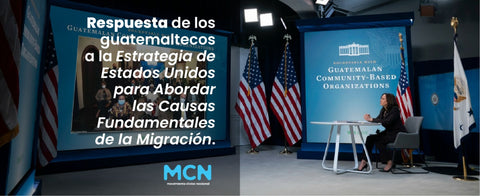
As part of the efforts carried out by the current Biden-Harris administration, the United States Strategy to Address the Root Causes of Migration in Central America was recently published. In five pillars, it tries to provide guidance on how to reduce migration, especially from the Northern Triangle countries.
United States Strategy to Address Migration
The National Civic Movement considers it crucial to be able to respond to this strategy. An important point is to take into account the local perspective that will lead to efficient and long-term sustainable implementation.
As citizens, concerned about Guatemala's prosperity and governance, we believe it is important to highlight the role of Guatemalans in solving the problems that lead to migration. Therefore, this response to the strategy was made taking into account the opportunity it represents for Guatemalans to provide our perspective on it.
At the same time, we aim to delve into the shared objectives and responsibilities between both countries, as well as the potential opportunities and challenges of the published strategy. The main focus of this response is to demonstrate that there are actors with the capacity and willingness to participate in improving Guatemala and thus achieve a reduction in migration.
What leads to Central American migration?
Over the years, we have realized that the lack of opportunities in the region has contributed to the brain drain of Guatemalan talent to the United States. This is a challenge we must solve.
The causes of migration cannot be focused on just one factor. Violence, insecurity, lack of employment, and corruption are factors that have encouraged people to seek a better quality of life in other countries, mainly the United States.

Nothing replaces political will
First, we agree that assistance from other countries cannot replace the political will required for change in the country.
We see civil society, associations, and local business owners as relevant actors in driving a reform agenda. Above all, one focused on strengthening the rule of law, improving the political system, and generating economic opportunities.
Generation of economic opportunities to reduce migration
In the pillar related to the economy, we agree that the first step should be to promote an adequate environment for the generation of employment opportunities. For these opportunities to be useful in the short term, it is essential to focus attention on programs that generate prosperity for the beneficiaries.
It is necessary to guide ourselves based on which cooperation efforts have worked and which have not. This way, improvements can be made by directing cooperation towards programs that can generate self-sufficiency. In the long term, this is sought, rather than relying on aid for a longer period.
It is beneficial for Guatemalans and American taxpayers that funds are invested appropriately, focusing more on quality than quantity.
Strengthening the Rule of Law
Regarding the Rule of Law, this will be possible if institutions and norms are strengthened, rather than the individuals who may temporarily occupy a position within them. This will contribute to lasting success in the pillar that seeks to combat corruption and strengthen democratic governance.
Another crucial factor is the necessary reforms that minimize discretion in the use of public power and resources. The opportunity presented by the modernization of the Judicial System should not be overlooked. Modernization will help reduce discretion and increase its effectiveness and transparency.
A Triangle with different sides
We know that there are multiple opportunities and challenges when implementing a strategy to address the fundamental causes of migration.
Central American countries have many similarities, but their differences should not be overlooked. The reasons for migration vary in each country at the national level, and also at the local level within each one.
Role of local actors in migration
Finally, the experience of local actors and others who can join forces to strengthen the cooperation relationship and the implementation of solutions should be leveraged. This could contribute to building monitoring, follow-up, and evaluation mechanisms.
We must seize the opportunity to be an actor willing to collaborate compared to neighboring countries. It is favorable that in Guatemala there are already collaborations among diverse groups to advance a reform agenda that seeks to solve the causes of migration. Because, as the strategy mentions, "the United States cannot do this work alone."