
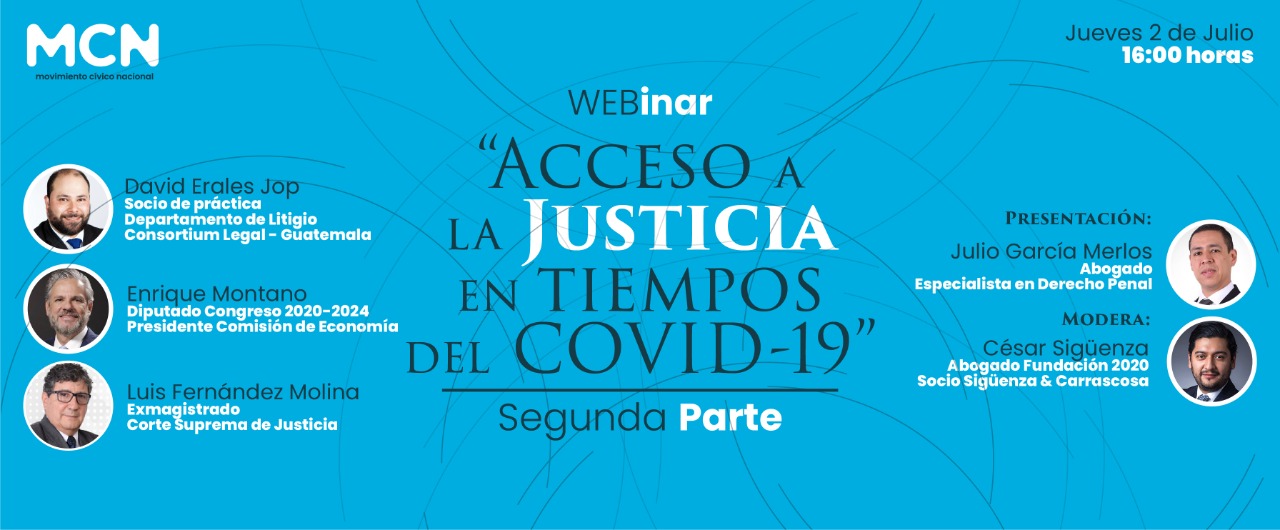

On July 2nd, the second webinar on Access to Justice in Guatemala during Covid-19, part 2, was held.
This time, the event featured the participation of lawyers César Sigüenza, Julio García-Merlos, David Erales, and former Supreme Court Justice Luis Fernández Molina.
The 4 panelists reflected on the shortcomings of the justice system in Guatemala. The lawyers proposed some solutions to ensure access to prompt and efficient justice amidst the COVID-19 pandemic.
You can watch the full video here:
The crisis, an opportunity to improve justice in Guatemala
In the first part of the webinar, lawyer García-Merlos showed that the justice system was already collapsed even before the COVID-19 emergency.
He referred to a CIEN study estimating the overall efficiency of the justice system in 2018 at 33.2%.
He commented that currently, there is an opportunity to use new technologies such as electronic notifications and videoconferences. This is because, in some cases, oral hearings are unnecessary and could be processed in writing.
On the other hand, he also emphasized that there is a need to reevaluate criminal policy, the strategy for resolving cases, and to encourage resolutions through alternative means.
What can the judiciary do, without the need for legal modification, to guarantee access to justice?
Lawyer Fernández Molina indicated that one option could be the use of ankle monitors to decongest the system.
Regarding the Supreme Court of Justice, he commented that it is very limited. Administrative measures can be appealed or challenged before the Constitutional Court, which has greatly diminished its role.
Former magistrate Fernández also emphasized that the Judiciary has deteriorated because the courts are not working. The scenario that awaits at the end of the COVID-19 pandemic is worrying, concluded Fernández Molina.
On the other hand, lawyer David Erales stated that the COVID-19 pandemic only reflects how bad things are. In his opinion, the justice system was already overwhelmed even before the pandemic.
Erales highlighted that it is important to rethink how to obtain justice with closed courts.
It is important to reactivate the entire judicial framework to address all the needs of the various branches and to achieve the social justice that is so sought after.
David Erales
He referred to a ruling by the Constitutional Court from 2015, which states that:
The obligation to guarantee justice entails the duty to adopt the measures deemed pertinent to do so, according to its needs and current conditions.
Constitutional Court Ruling 2015
Finally, lawyer Erales emphasized the need to implement more courts and more capacity to meet demands.
What's missing to understand that access to justice is key for a country?
Lawyer García-Merlos commented that the budget issue is something that needs to be addressed and reviewed, as judges do not have sufficient resources to work.
In his opinion, the Supreme Court of Justice should not wait for changes to occur; this crisis should serve to reevaluate inefficiencies.
Lawyer Fernandez Molina and lawyer García-Merlos agreed that despite identifying a general aversion to certain electronic changes, it is important to transition to a more efficient system.
Both lawyers referred to the electronic notification system, emphasizing its validity since 2011. It is not something new, but it is voluntary, they stressed.
In conclusion, García-Merlos said that there are incentives that do not help everything be done electronically, so change must be enforced.
The incorporation into the electronic notification system should be mandatory for litigants, not voluntary. As resistance to change would not allow its immediate implementation, said García-Merlos.
On the other hand, magistrate Fernández Molina emphasized that it has been a cultural issue and that it must be reformed to expedite.
At the same time, lawyer Erales commented that processes must be unblocked, and the role of lawyers is necessary to achieve changes. From law firms and classrooms, this paradigm shift must be sought to make improvements to the system.
Is a legal change necessary?
Lawyer García-Merlos stated that before considering legal changes, a diagnosis of the judicial system must first be made.
On the other hand, former magistrate Luis Fernández Molina said that more information is needed and that legal adjustments are necessary regarding amparo actions, as not all of them should be heard.
Lawyer Fernández concluded with this question:
If we doubled the courts of the republic, would the judicial backlog be cut in half, or would we still be dragging that backlog?
Luis Fernández Molina
In conclusion, Jose Echeverría, Executive President of the National Civic Movement, emphasized the importance of reflecting on the shortcomings of the judicial system and improving them.
He highlighted that this is necessary to guarantee prompt justice and to be able to develop as citizens and grow as a country.
As a Movement, we commit to developing or identifying these conclusions and delivering them to the authorities. This is with the aim of showing them that there is an engaged citizenry that will demand they work to improve access to justice.
José Echeverría