
Next April 14, the new magistrates of the Constitutional Court for the 2021-2026 term will take office.
The election of those who will make up the country's most important constitutional court is of great significance for Guatemala.
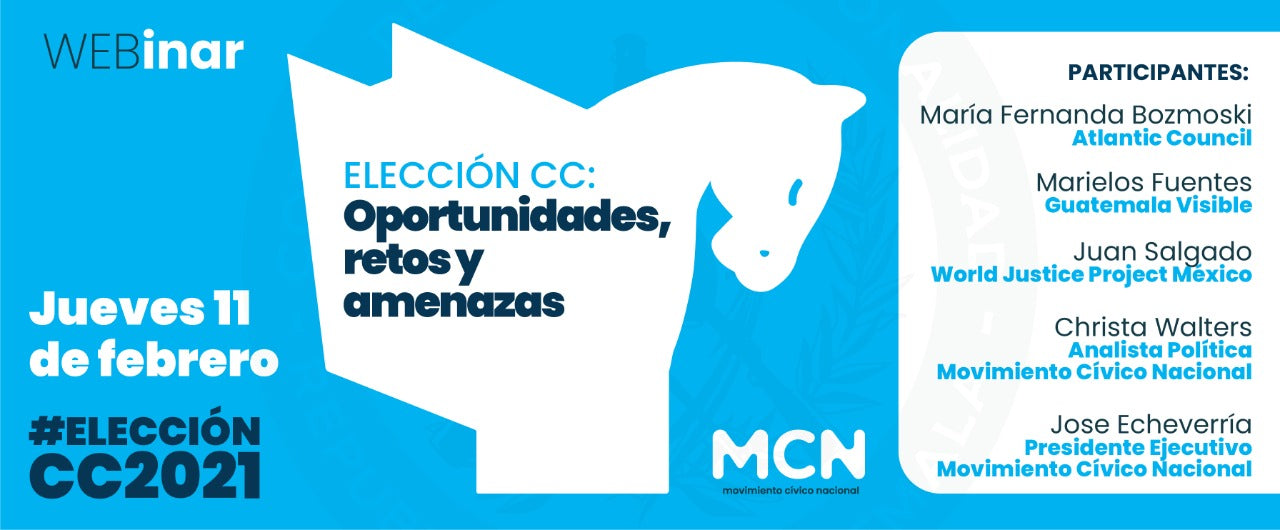
The National Civic Movement held a webinar to address the opportunities, challenges, and threats posed by this election.
The event featured exclusive guests and experts on the subject, including:
- María Fernanda Bozmoski from Atlantic Council
- Juan Salgado from World Justice Project
- Marielos Fuentes from Guatemala Visible
- Christa Walters and José Echeverría from the National Civic Movement
Relevance of the election of the Constitutional Court for Guatemala
The election of the Constitutional Court and the Rule of Law
Juan Salgado from World Justice Project explained that when talking about the Constitutional Court in Guatemala, it must be remembered that it is a fundamental pillar of the Rule of Law and a state body.
The expert explained that in theoretical terms, the Rule of Law is the legal-political institutionalization of democracy.
This means that there is a legal part which is a normative basis that provides the entire legal perspective. But on the other hand, there is a political basis which is legitimacy. That is to say, if the norm is complied with, it is because there is belief in the norm.
The Rule of Law also has an important surname, which is the democratic Rule of Law. Therefore, when we think of a democratic Rule of Law, we must think that the law is obeyed because it is legitimate, that is, because we agree with this law. On the other hand, in authoritarian and totalitarian regimes, the law is obeyed because there is repression behind it.
The expert explained that in that sense, the Constitutional Court, due to its jurisprudence and its functioning, is very legitimate in terms of its formation.
There are 5 principal magistrates and 5 alternate magistrates appointed by the executive, legislative, judicial branches, the University of San Carlos, and the Bar Association. That is to say, this should provide a very important legitimacy to a Constitutional Court like Guatemala's.
Importance of the Constitutional Court
Marielos Fuentes of Guatemala Visible explained that the Constitutional Court is the most relevant constitutional institution in Guatemala for maintaining the Rule of Law and respect for legislation.
The Constitutional Court offers, with its legislation, not only a collegial opinion that is unappealable but also one that must have the legitimacy and respect of citizens. This contributes to accepting its resolutions whether we like them or not.
Marielos Fuentes
In Guatemala, even in electoral matters, the Constitutional Court will make decisions, the expert explained. Politically speaking, it will have great relevance, as was observed very intensely in the 2019 General Elections in the country.
It is for this reason that the Constitutional Court is attracting greater interest than in previous years from all political parties and other political entities. On this occasion, they are seeking to have more visible influence in one way or another.
At this moment, everyone is doing everything possible to gain power through the Constitutional Court, Fuentes emphasized.
The relevance of the election of the Constitutional Court
On the other hand, Christa Walters of the National Civic Movement explained the great relevance of the Constitutional Court in the legal system.
The essential function of the Court is the defense of the country's constitutional order.
Christa Walters
Ms. Walters explained that the relevance of the election can be seen from two perspectives:
- How the designation process will unfold.
- The result of said designations.
First, how the process unfolds will be important for the Rule of Law and the country's institutions. This is in the sense that it must be governed by legal and constitutional parameters that are ordered. Therefore, if it complies within this, it will be providing certainty that the pre-established rules of the game are being met.
On the other hand, the outcome of the designation is also important. The elected magistrates have an enormous responsibility to contribute to giving life or ordering interests, objectives, and values within the country's political life. These interests must remain within the parameters and limits established by the Constitution, Walters explained.
International perspective on the election of the Constitutional Court
Maria Fernanda Bozmoski of the Atlantic Council began her intervention by alluding to the fact that it is the first time in a long time that the election of the Constitutional Court has attracted so much international attention.
This election goes beyond the mandate of the next magistrates. The election will have implications beyond a simple election, the expert explained.
It is important that the profiles and magistrates who make up this body, which is the ultimate defender of the constitutional order, meet the minimum requirements.
Guatemala is under international scrutiny, and what happens in these coming months with this election will have implications beyond just who makes up the Court.
Maria Fernanda Bozmoski
The expert concluded by saying that there is a new administration in the United States that is paying a lot of attention and resources to the fight against corruption. This is especially true for the countries of the Northern Triangle.
What is the Rule of Law and what does alternation in the judicial power imply for a Rule of Law?
In Juan Salgado's opinion, the concept of Rule of Law is broad, but there is a definition they have formed from the World Justice Project.
The Rule of Law is a system of rules in which all people, institutions, and entities are subject to the law, which is applied equitably and justly with full adherence to human rights.
The expert explained that in the Rule of Law, and especially in the Constitutional Rule of Law, rules are followed.
Following the rules with the four universal principles allows for the validity of the Rule of Law:
- Accountability
- Just Laws
- Open Government
- Access to Justice
On the other hand, the expert explained that the Constitutional Court is important for the Rule of Law because, as Kelsen explains, Constitutional courts are a negative legislator. That is, they are not creating new laws, but they have the possibility of eliminating laws that are not in agreement with the constitutional text, with the spirit of the Constitution.
That is the function of guardian and respect for rights and legality.
Juan Salgado
In conclusion, the Constitutional Court is important because it limits governmental power. This is one of the factors of the World Justice Project's Rule of Law Index, Salgado explained.
For the legal certainty of foreign investment, it is fundamental to have transparency mechanisms in the judicial power. This is why the election is also so important from an international perspective, the expert concluded.
The relationship between the Rule of Law and a country's development
The expert from the Atlantic Council explained that the organization's work with the region involves developing recommendations for public policy.
On the other hand, Bozmoski said that as long as there is no legal certainty, there will be no foreign investment in the countries.
The rule of law plays a fundamental role in the functioning of a stable and well-governed country. Open governments and transparency are prerequisites for a country to be considered a destination for foreign investment, the expert explained.
A country must generate that trust in the private sector that the rules will not change at the last minute. Even the World Bank, in its Doing Business reports, emphasizes the importance of respect for the Rule of Law and the rules of the game.
On the other hand, the importance of a framework of legal certainty for the flow and presence of investments within the country is highlighted. These investments ultimately generate economic opportunities, Bozmoski concluded.
What is the status of the court election process in Guatemala?
Marielos Fuentes from Guatemala Visible explained that in these processes it is difficult to generalize because there are 5 instances involved.
The processes of Congress, the Supreme Court of Justice, CANG, and the Superior University Council have established some mechanisms that facilitate citizen oversight. These processes guarantee transparency but not substantial improvements in the processes, said Fuentes.
On the other hand, the Judicial Branch and the University of San Carlos are setting up digital platforms that are easily accessible, which is a good step.
The expert explained that immediate information is available from the Bar Association meetings. This is positive because it allows knowing who is running and the candidate's background.
All of this has been important because it allows citizens to see if an aspirant has a trajectory contrary to the profile and what the law requires. This openness has been very positive, the expert said.
On the other hand, there has not been the same openness from the executive branch. This is difficult to question because the law does not oblige any instance to do so. However, it would be good will to know the names from the executive, as President Berger did in his time, Fuentes said.
Guatemala Visible received information from the presidency that the election will be held as the law states, in a meeting of the council of ministers when the time is near. Therefore, this will be in March.
The expert concluded by saying that there is a good relationship with the other entities that are opening up the process. For its part, Congress has already announced its candidates. But there is still no clear mechanism for how citizens will be able to express themselves.
What is the public perception of how the process is going?
In Christa Walters' opinion from the National Civic Movement, it is difficult to generalize about how the process is going. This is because there are 5 institutions that can carry out different methodologies for the designation.
The National Civic Movement used 3 dimensions to create a proposal for a timeline and best practices document for these institutions that appoint magistrates. This was to ensure certainty about how the process would unfold, but also to provide it with transparency or publicity, which is not necessarily legally mandated, Walters explained.
Three Dimensions
Among the dimensions, the legal aspect or compliance with the law is first. This includes minimum requirements in constitutional laws for appointments to be made. If institutions comply with these minimum requirements, a process will be carried out as indicated by law.
On the other hand, if they provide instruments that offer greater transparency and publicity so that citizens are aware and know what is happening, it is a movement that promotes trust, Walters highlighted.
Second, to observe the performance of institutions, one can compare how the same Constitutional Court elections have developed in the past.
For example, 5 years ago, Congress established an inter-party commission to evaluate the candidates' files and use different instruments. However, this time, Congress has done the bare minimum in terms of publicizing the call for applications. Its timeline does not include instruments such as a grading table, an ideal profile, or more in-depth interviews to evaluate candidates.
Finally, attorney Walters explained that it is necessary to compare what these institutions do or the overall performance of the process with other similar processes. This is to consider what dangers or flaws might exist to prevent them from recurring in this process of appointing magistrates.
Relevant elements in the election within the international sphere
Maria Fernanda Bozmoski alluded to the fact that this U.S. administration comes with a different set of priorities and perspectives for the Central American region.
The expert explained that during the U.S. electoral campaign, Biden's team released a plan for Central America, and it was the only region in foreign policy for which they developed a comprehensive plan.
During the Obama presidency, when current President Joe Biden was Vice President, he traveled to the region and to Guatemala approximately 16 times, Bozmoski said.
This new administration is willing to strengthen U.S. ties with the Central American region, especially with the Northern Triangle.
Central America is a priority for the United States, and the number one priority in the region is the fight against corruption and impunity. The expert explained that this is why the election of the Constitutional Court has become so widely publicized. This election has even prompted statements from the State Department about the importance of a fair and transparent process.
This election has implications that extend far beyond this term of the Constitutional Court. It will set the tone for President Alejandro Giammattei's fight against corruption and the vision with which the United States will view the region and address priority issues with Guatemala, Bozmoski emphasized.
What elements should be considered in a process of judicial power alternation?
Juan Salgado explained that there are different models and elements that vary from one power to another in Latin America. The expert emphasized that the U.S. Ambassador to Guatemala, William Pop, has been making statements about the Constitutional Court and the election process.
It is important for civil organizations to remember that they have alliances. They must be clear that in Guatemala there is an actor pushing an agenda in line with the State Department. There is a new administration in the United States that is seeking these important changes for democratization in Guatemala.
Power alternation in the process
On the other hand, to measure power alternation in the election process, Dr. Salgado recommended focusing on two points of the World Justice Project index:
- First, the factor of limits on governmental power. The Constitutional Court is an instance that, based on the interpretation of the norm, can establish limits on any abuse of power and defend citizens' rights.
- Second is criminal justice. In terms of criminal justice, there are broad international evaluation parameters such as access to justice and the quality of justice.
A significant part of a constitutional court's management is evaluated based on these two indicators. Regarding how the interpretation of the norm by the constitutional court guarantees or does not guarantee access to justice, and how this entire constitutional review leads to a better quality in the administration of justice.
Guatemala's score
In the factor of limits on power, Guatemala is right in the middle within the Region. On the other hand, in criminal justice, there has been a setback between 2019 and 2020, Salgado said.
In the regional ranking, Guatemala dropped 3 points in the criminal justice factor, placing it in 101st position out of 128 countries evaluated.
Guatemala, in the factor of limits on power, has an average score of 69 out of 128 countries evaluated. In criminal justice, it is far behind, with a position of 118 out of 128 countries evaluated, Salgado said.
Finally, the expert said that the factor of limits, being in the middle, is not an entirely discouraging result. Therefore, it is necessary that these election processes legitimize what has been gained and that the ranking can be maintained.
What can be expected from the Constitutional Court election process?
Marielos Fuentes explained that almost all deadlines for submitting candidacies are currently ending. So far, the process has been open.
This has given citizens the opportunity to present evidence to the nominating body regarding candidates who do not meet the required profile.
As a risk, Ms. Fuentes observes that this appointment could be postponed. In her opinion, this would be fatal for our system and for the rule of law in the country.
It would be falling into a country where the rules written in the Constitution of the Republic are not important.
Marielos Fuentes
The expert concluded by emphasizing that the norm should not be manipulated to achieve something good. We must understand that norms exist and that it is important to act within what our legal framework indicates, Fuentes said.
How can citizens support the process of electing magistrates?
Christa Walters explained that an active citizenry is important, and above all, it is important to stay aware of what is happening in the process and to follow how it is being carried out in detail.
Citizens must go a step further and not just be spectators, or demand from a position of comfort, but present proposals for "how do we think it should be carried out or what can we demand of these magistrates?" Walters explained.
Having an ideal profile is an important, though not mandatory, tool that is useful for evaluating magistrates, Walters said.
An ideal profile allows citizens and the institutions that will use it to have tools to evaluate an ideal magistrate and what is expected of the appointed magistrates.
Walters highlighted that this must be separated from the basic requirements set out in law. The requirements stipulated in constitutional laws are a way to distinguish who can participate and who cannot.
On the other hand, the ideal profile applies to those candidates who have already passed the minimum requirements filter, and then components or elements of their personal or professional lives are evaluated, the expert said.
Elements of the ideal profile
In the ideal profile, elements such as independence and impartiality can be discussed. That the resolutions or actions of the magistrates demonstrate independence and objectivity to honor the position.
On the other hand, it is also expected that magistrates have the quality of honorability, that their trajectory demonstrates an unblemished conduct.
Another important part of this profile that can be proposed by citizens is that the elected magistrates have the preparation of knowledge, skills, and legal and analytical abilities. This is because the selected magistrates will serve in a court of great importance.
The resolutions or judgments of the Constitutional Court even become jurisprudence, Walters explained. Consequently, the elected magistrates must know how to consider the country's reality, have knowledge of rights, and also commit to the defense of individual rights established by the constitution.
Finally, the expert mentioned that this ideal profile tool is important for citizens. If what is expected of the magistrates is established from the beginning, they can later be held accountable based on this profile.
Attorney Walters alluded to the fact that the proximity to judges or magistrates is different because citizens do not vote for them, as they do for the president or deputies. Therefore, in this case, certain accountability can be demanded.
In conclusion, an ideal profile is a useful citizen tool to hold magistrates accountable afterward based on their actions, the expert emphasized.
The region's position on these issues
Maria Fernanda Bozmoski began by saying that forums and organizations such as the National Civic Movement are important for informing and involving citizens in these topics that are relevant to everyone. Without civic participation, democracy dies, the expert explained.
Bozmoski explained that these are not problems or unique obstacles in Guatemala. On January 6, we observed that democracy can falter a bit, and the United States is an example, the expert said.
What happened here is an example and a lesson that no democracy is immune when processes are not fully transparent or are not the best. Democracy can falter and these kinds of problems can happen.
Maria Fernanda Bozmoski
Bozmoski explained that what happened in the United States was an attack on the Capitol. This attack reflected how disinformation problems are common to all democracies and no country is an exception.
Even the democracy with the most tradition—the United States—is susceptible to weaknesses and external and internal threats. That is why the work done by the National Civic Movement is extremely important, Bozmoski said.
How to evaluate and analyze what to improve for the next Constitutional Court election?
Dr. Salgado explained that the issue of corruption is very important for the Northern Triangle. Not only because of international cooperation and the United States' interest in this issue, but especially because this new administration gives it more importance.
Models like CICIG in Guatemala and MACCIH in Honduras have already been surpassed. Last year, in Guatemala, a specific commission for corruption was even created, Salgado said.
Large umbrella models like CICIG and MACCIH in the region have already been implemented, now it is important for the government to fight corruption, but they are doing it from within the government itself.
It is vital to create an autonomous body with government funds but with citizen participation, the expert explained.
In Salgado's opinion, the way forward is to propose formal citizen mechanisms for supervision, transparency, and adherence to legality in these types of judicial elections.
Legislative review
The expert highlighted that legislation is needed to establish mechanisms as part of the election process in which citizens are formally involved.
On the other hand, also in terms of legislative review, it is important not to renew the court all at once, but in parts. It is not necessarily convenient for all magistrates to be renewed at the same time to ensure continuity in practice. Experience is important, and if an entirely new group arrives, it is important not to lose that experience, the Doctor emphasized.
Professional career service and legal research service
Salgado explained that it is important to discuss a professional career service and permanent legal research and jurisprudence service. That is, to have a core staff that remains in the institution and, through a career service, can stay over time to serve as institutional memory.
On the other hand, it is vital to develop metrics and indicators to evaluate transparency and adherence to the law in judicial election processes.
If we look at how Guatemala is today in terms of civil society's competence to analyze data and compare it to 15 years ago, it's a 180-degree difference. Guatemalan civil society has become involved in data analysis, demanding that the government generate data, and transforming this data into information, Salgado said.
The expert alluded to the fact that civil society often has to do the government's work. Therefore, it must be encouraged and supported to develop these metrics and indicators to evaluate transparency and adherence to the law in judicial election processes.
This parameter is important because it allows us to say whether things are done well or poorly. This is not only based on contextual information but also on criteria, protocols, and metrics that allow us to evaluate if it is being done well and, if so, to reward it, Salgado concluded.