
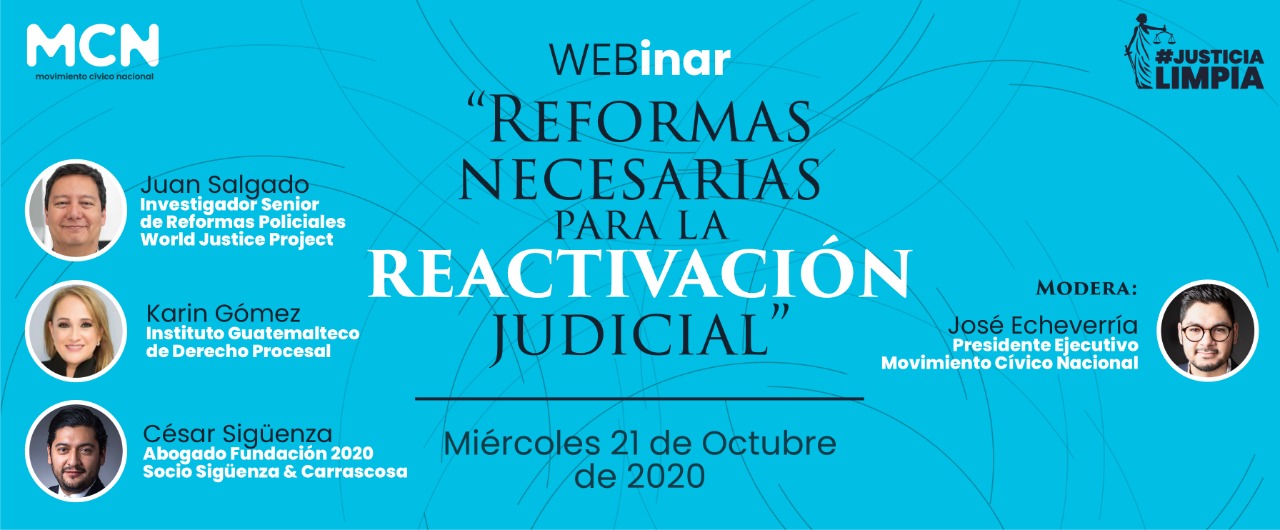
Last Thursday, October 21st, the Webinar “Necessary Reforms for Judicial Reactivation” was held.
The event was moderated by the Executive President of the National Civic Movement, José Echeverría, and featured the participation of:
- Juan Salgado, Senior Researcher of Police Reforms at the World Justice Project.
- Karin Gómez from the Guatemalan Institute of Procedural Law.
- César Sigüenza, lawyer for Foundation 2020 and partner at Sigüenza y Carrascosa.
Second-generation reforms
During the first part of the Webinar, Dr. Juan Salgado emphasized that Guatemala is a country undergoing second-generation reforms in the judiciary.
Salgado said that Guatemala had an initial reform in which oral procedures were adopted. In addition, important transformations were made in actors such as prosecutors' offices and the Public Ministry.
On the other hand, he emphasized that second-generation reforms should focus on two aspects highlighted by international jurisprudence:
- Access: this means guaranteeing equal access to justice. Laying the groundwork for enjoying the rights that a modern and democratic judiciary should guarantee.
- Quality: quality in the service related to justice must be guaranteed.
The Rule of Law Index
The Rule of Law, according to Salgado, is a broad concept that relates to the legitimacy that the regime of any country should have and the fulfillment of rights.
Few countries have not been covered by this Rule of Law Index. There is a measurement of 128 countries and jurisdictions in total.
Guatemala in the Rule of Law
Guatemala ranks 101st out of 128 countries evaluated and is in 25th place out of 30 countries in the regional ranking.
From 2019 to 2020, the country dropped 5 positions; in 2019, it was ranked 96th out of 126 countries evaluated.
According to Dr. Salgado, it is important to consider where Guatemala's declines occurred.
The country saw a drop in the factors of limits to governmental power and absence of corruption. Consequently, Salgado highlighted that these are points to consider for criminal procedural reform.
From one year to the next, there has been a considerable decline in the limits to power, and the judiciary is the fundamental limit to executive power.
In conclusion, according to the expert, second-generation reforms require a very important technical framework. Additionally, they also require justification to advance through the legislative process.
Main challenges in the administration of justice
Karin Gómez of the Guatemalan Institute of Procedural Law began her intervention by highlighting that the administration of justice is a basic service that must not cease to be provided.
She highlighted that as a result of the time that judicial deadlines were suspended, there was a high presentation of a large number of lawsuits.
Therefore, the challenges of using technology must be taken into account in this context. It is important to get used to electronic notification, which is key to advancing processes, according to the lawyer.
On the other hand, the panelist emphasized that there are reform challenges to simplify the process of unifying all incidents and appeals. Guatemala has many means of challenge in the expert's opinion.
In conclusion, the challenges lie in three aspects: changing mindsets, using technology, and new judicial office practices.
In other words, it is crucial to change the mindset of the person in charge of the court for processes to advance.
How can reforms be viewed from a more practical administrative law perspective?
César Sigüenza, a lawyer at Fundación 2020, began his intervention by saying that system improvement should be continuous. Therefore, in the expert's opinion, this is an opportunity to enter the world of technology.
From the most developed courts in the world to some countries in less modern regions, technological means have been used to address this access problem.
What key aspects should be reformed?
Sigüenza said that Fundación 2020 has been monitoring key aspects for improving the judicial system:
First, the judiciary, as one of the three pillars of the state's functioning, must be endowed with a capacity for self-regulation.
As a result, this will allow the incorporation of necessary tools to address the circumstances that may arise.
On the other hand, it is also necessary to manage the office digitally on a platform that allows the real-time monitoring of hearings.
Finally, it must be considered that not only legislative but also cultural change must occur.
The expert stressed that it is important to have accompanying measures regarding institutional culture and work culture. Both need to be modernized to change the ways, customs, and practices that occur in courts.
Cultural change must happen in conjunction with reforms, Sigüenza emphasized.
Continuity in modernization reforms
According to Sigüenza, legislative changes should be promoted, and at the same time, monetary and human resources should be provided so that the courts can modernize.
Unfortunately, currently, the judiciary lacks clear continuity regarding modernization policies.
Therefore, there must be an administrative management that is responsible for institutionalizing the processes of updating and modernization. This, in the expert's opinion, is a small change in the law of the judicial body.
Finally, Sigüenza stressed that despite the fact that changes are on the legislative agenda, which is important, pressure must be exerted for there to be a task of accompaniment and training so that the reforms can be well implemented in practice.
How to measure reforms made to a judicial system to determine if they are being well implemented?
Juan Salgado emphasized that the change needed in Guatemala is significant due to being a shift in institutional culture. Therefore, it is necessary to review international practice, which is extremely important.
For example, in Latin America, there are councils of the judiciary with administrative functions that extend beyond the term of judges and magistrates in office.
As a result, this allows for transversal actions in judicial policy that enable modernization and continuous training for judges.
On the other hand, Salgado also gave the example of the measurement metric in the European Union in terms of the judiciary, which is oriented towards two service indicators:
- Citizen satisfaction with the service received from the judiciary.
- Jurisdictional quality, i.e., quality in processes, time issues, and efficiency.
Setting objectives in reforms
On the other hand, according to Salgado, it is important to be oriented towards achieving objectives.
If there is a reform program, objectives must be derived from it, and from the objectives, targets, which will be intermediate steps to reach the grand long-term objective.
This results in a monitoring base, and monitoring dynamically allows observing how a judicial institution performs.
Monitoring provides us with this data density to be able to conduct an evaluation later on.
Finally, it is important for the judiciary to commit to generating this data. Based on monitoring and indicators, goals can be met.
Once this data is generated, information can be obtained to measure the performance of the judiciary.
It is important that every legislative reform effort includes a module on measurement and evaluation, which allows for a long-term view of whether it was successful or not.
Reforms in Latin America are carried out without these metrics, and today we are paying a very high price for it, according to Salgado.
How can citizens support and monitor reform evaluation?
Karin Gómez highlighted the importance of paying attention to reforms. For example, in the civil area there have been 5 attempts at reform, but what is needed in the day-to-day in courts is not analyzed.
In Gómez's opinion, the way citizens can help is by training assistants and judges. For example, the expert believes it is vital to generate a change in thinking and in the adoption of new ways of viewing the process, to turn it into a modern process.
Gomez said that awareness must be raised that the judicial system's service should be of quality through training to provide better service. Consequently, citizens and associations can hold forums, talks and spread knowledge.
Juan Salgado, in his speech, emphasized the importance of viewing judicial reform as a state reform. We see the judiciary as a service, however, in addition to being a service, it is a function of the State, he stressed.
Therefore, this reform is a degree of responsibility for the state apparatus. As a result, this places judicial reform above others.
The role of civil society should be to provide arguments to the legislature in terms of priority.
From an activism point of view, it must be argued before the legislature why this function of the State is a primary reform to prioritize.
Can reforms provide an opportunity for small but momentous changes?
In Karin Gómez's opinion, the important thing is to make electronic notification mandatory. Most processes and litigating lawyers have not joined this modernization process.
The lawyer highlighted that some lawyer judges take it as a bad practice to hinder processes.
On the other hand, lawyer Sigüenza emphasized that crises provide opportunities, and on this occasion we see how records can be improved through electronic operations.
We have seen how public offices can operate by appointment and make their work more efficient. The case of the judiciary should be no exception.
Sigüenza stressed that there are several cultural problems that we have to face. Improvement is a continuous process; there will come a day when we hit a wall, he emphasized. Consequently, we must always seek modernization and efficiency.
Finally, José Echeverría, the Executive President of the National Civic Movement, said that the judiciary is a function of the state. Therefore, it must be guaranteed that justice is prompt and duly administered.
In Echeverría's opinion, judges must have the necessary tools to perform that function efficiently.
The judicial system must be continuously improved, and adjustments must be made to this function of the State to achieve an increasingly consolidated rule of law.